
Squirrels
Squirrel Profile
| Feature | Details |
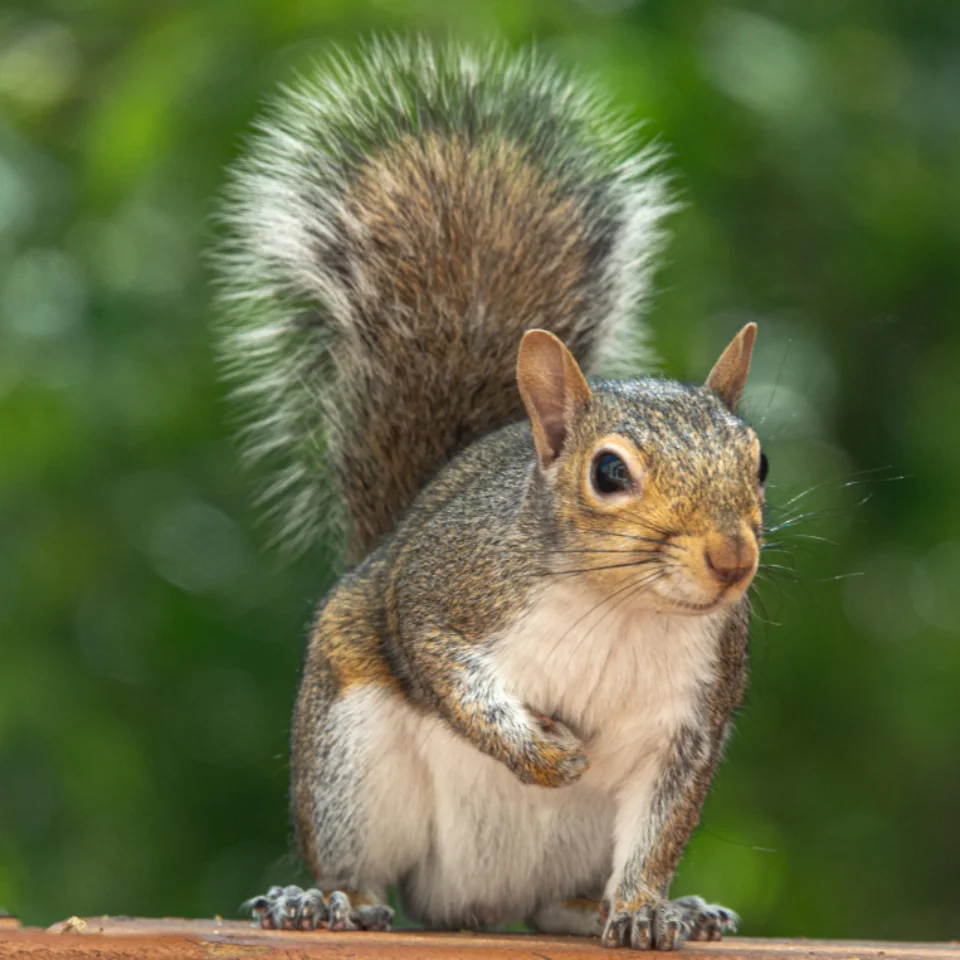
| Common Species | Eastern Grey Squirrel (Sciurus carolinensis) |
| Activity Level | Diurnal (Active during the day) |
| Common Entry | Roof vents, soffits, and rotted fascia boards |
Key Identification
If you have “noises in the attic,” timing is the best way to identify a squirrel vs. a rat.
- The “Morning Scramble”: Squirrels are active at dawn and throughout the day. If you hear heavy scratching and scampering at 7:00 AM, it is likely a squirrel. (Rats are nocturnal and move at night).
- Exterior Clues: Look for “chew holes” the size of a golf ball or larger near the roofline.
- The “Teeth” Factor: Squirrels are rodents with teeth that never stop growing. They must gnaw on hard surfaces to keep them filed down. In an attic, this usually means your home’s structural beams or AC ductwork.
About Squirrels in Florida
In the Sunshine State, squirrels don’t hibernate. They are active year-round, especially during their two peak breeding seasons – usually winter and summer.
Southwest Florida and Orlando areas have a lush canopy of Live Oaks and Slash Pines which provides squirrels with an endless supply of food and easy “highways” to your roof. Once they decide your attic is a safe place to raise their young, they can cause thousands of dollars in damage. They are also notorious for chewing the lead “boots” around plumbing vent pipes, which leads to roof leaks during Florida’s heavy afternoon summer thunderstorms.
How to Treat
Because squirrels are intelligent and agile, “DIY” fixes like mothballs or strobe lights rarely work. We use a Humane Trapping & Exclusion approach.
- Comprehensive Inspection: We locate all active and “potential” entry points. Squirrels often have a primary hole and several “backups” they use if they feel threatened.
- One-Way Doors: We use specialized “one-way doors” that allow the squirrels to leave your attic to find food but prevent them from re-entering.
- Structural Exclusion: Once we are 100% certain the squirrels are out, we seal the entry points using “rodent-proof” materials like heavy-duty hardware cloth, metal flashing, and high-performance sealants.
- Tree Trimming (The “Bridge” Removal): We recommend trimming any branches back at least 8 to 10 feet from your roofline. If they can’t jump to your roof, they can’t get into your attic.
Frequently Asked Questions on Squirrels
Can I just seal the hole while the squirrel is inside?
No. This is a common and costly mistake. If you trap a squirrel inside, it will chew frantically through drywall, wires, and PVC pipes to get out. If it dies inside, the odor in the Florida heat will be overwhelming. You must ensure they are out before sealing.
Are squirrels in the attic a fire hazard?
Yes. Statistics show that a significant percentage of “unknown cause” house fires are started by rodents (including squirrels) chewing through the plastic insulation on electrical wires, causing a short circuit.
Will a “fake owl” keep them off my roof?
Briefly, maybe. Squirrels are smart and quickly realize that a plastic owl that never moves isn’t a threat. Professional exclusion is the only permanent solution.
Our Orlando Service Locations:
- Orlando
- Clermont
- Apopka
- Windermere
- St. Cloud
- Winter Garden
- Lake Buena Vista
- Kissimmee
- Sanford
- Davenport
- Oakland
- Minneola
- Lake Nona
- Ocoee
- Longwood
- Lake Mary
- Oviedo
- Winter Park
- Altamonte Springs
Our Southwest, FL Service Locations:
- Fort Myers
- Cape Coral
- Naples
- Babcock Ranch
- Lehigh Acres
- Ave Maria
- Estero
- Bonita Springs
- Marco Island
- Sanibel Island