

Expert Advice from Infinite Pest Control | Serving Orlando & Southwest Florida
If you’ve ever spotted a cloud of winged insects suddenly emerging from your walls, floors, or yard — and felt your stomach drop — you’re not alone. Termite swarms are one of the most alarming things a Florida homeowner can witness. And yet, many people brush it off, assuming it’s just flying ants or a one-time event.
Here at Infinite Pest Solutions, we’ve been responding to termite swarm calls across Orlando and Southwest Florida since 2017. In that time, we’ve seen what happens when homeowners act fast — and what happens when they don’t. Spoiler: termites don’t take days off, and neither does the damage they cause.
In this post, we’ll walk you through everything you need to know: what swarming termites look like, when termites swarm in Florida, how long termite swarms last, what to do the moment you spot one, and why acting quickly is the single most important thing you can do to protect your home.
Do Termites Swarm? What Does a Swarm Actually Mean?
Yes, absolutely, and it’s one of the clearest warning signs that a colony is active on or near your property.
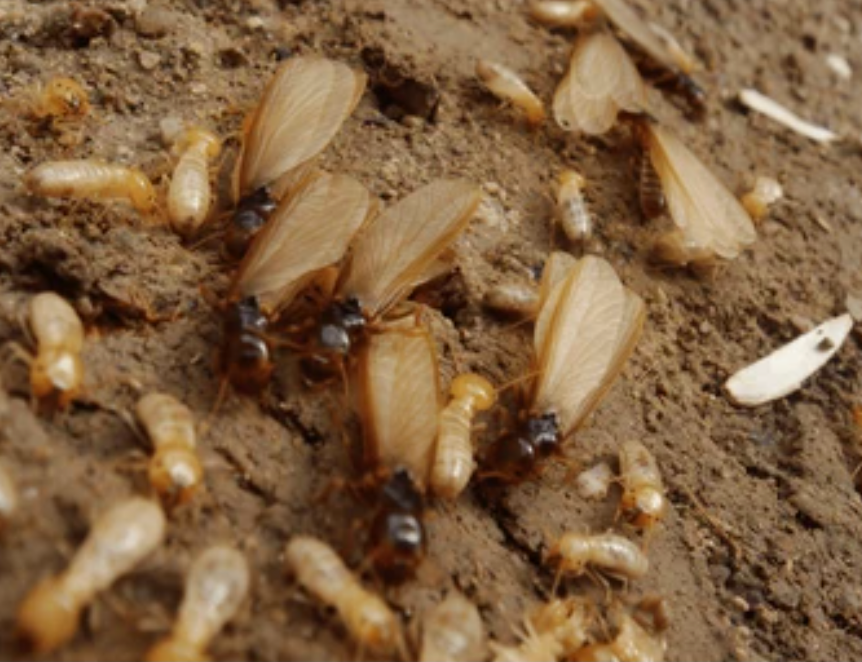
Termite swarmers are the reproductive members of a termite colony. When a colony matures, it produces winged termites that fly out in large numbers to mate and establish new colonies. The swarm itself is short-lived — but what it signals is serious: there is already an established colony nearby.
Many homeowners see a swarm and breathe a sigh of relief once the insects disappear. But the swarm is the symptom, not the problem. The colony behind it is.
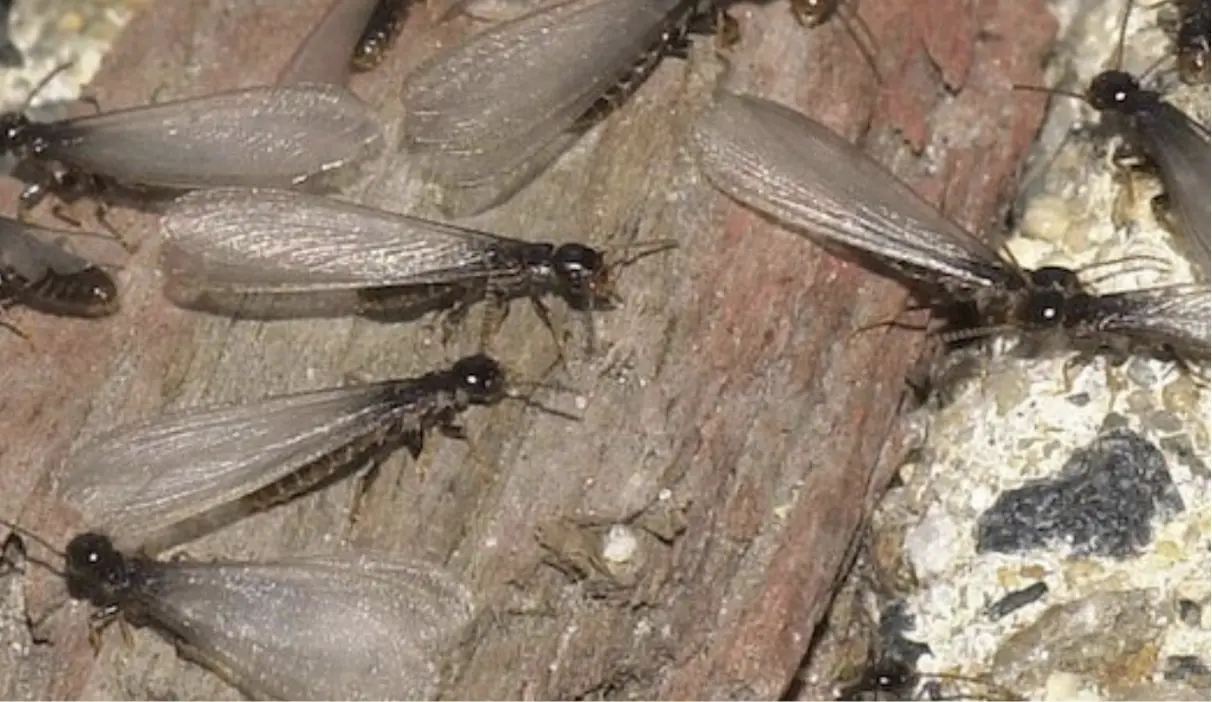
What Do Swarming Termites Look Like?
One of the most common questions we get — right after a panicked call — is: “Are these termites or flying ants?” It’s a fair question. Both swarm, both have wings, and in a moment of panic, they look almost identical.
Here’s the simplest way we explain it to customers: count the body sections.
- Termite swarmers have 2 distinct body segments (head and abdomen — the waist is barely visible)
- Ant swarmers have 3 distinct body segments, including a pinched, narrow waist
- Termite wings are equal in length and extend well past the body
- Ant wings are unequal — the front pair is longer than the rear pair
- Termite antennae are straight; ant antennae are elbowed
When customers text us a photo (which we always encourage), we can usually make a positive ID within minutes and get an inspection on the calendar right away. If you’re ever unsure, snap a picture and send it to us — don’t spray anything in the meantime.
When Do Termites Swarm? (And When Do Termites Swarm in Florida?)
Timing varies by species — and in Florida, you need to know both.
Subterranean Termites
Subterranean termites are the most destructive species in the state, and they’re the ones we deal with most across Orlando and Southwest Florida. Based on what we see every year on the ground, subterranean swarmers typically emerge:
- Late February through March — the early wave, often triggered by warm weather after a cool stretch
- April through May — peak swarming season for subterranean species
- Occasionally into early summer — depending on rainfall and temperature patterns
Swarms often happen after rain, on warm days, usually in the late morning or early afternoon. If you see a swarm inside your home, it almost always means the colony has breached the structure.
Drywood Termites
Drywood termites follow a different calendar entirely. In Florida, drywood swarmers are most active:
- Starting in summer (June–July)
- Continuing through fall (August–October)
Drywood termites don’t need soil contact — they live directly inside wood, which makes them particularly insidious. You might see their pellets (frass) before you ever see a swarm.
Florida Tip: We’re seeing a significant increase in termite activity across the state in recent years. If you live anywhere in Florida — especially in the Orlando metro or Southwest Florida — it’s not a matter of if termites find your home, but when.
How Long Do Termite Swarms Last?
This is one of the most searched questions we see — and the answer is both reassuring and sobering.
The actual swarm event itself is brief. Most termite swarms last anywhere from 20 minutes to a few hours. Individual swarmers that end up inside your home will die on their own within a matter of hours — they’re not equipped to survive without their colony.
So in terms of how long termite swarms last visually: not long. But here’s where people make a critical mistake — they assume that because the swarmers are gone, the problem is gone.
“Termites work 24 hours a day, 7 days a week. They do not sleep. Within a few hours to a couple days, new colonies can begin to establish. Waiting is never the right answer.” – Douglas Parker, Infinite Tech
We had a customer this year whose swarmer activity appeared in their mulch beds outside. We alerted them. They decided to wait. By the time they called us back, the swarmers had shed their wings and begun colonizing right there on the property. That’s how fast it can happen.
Real Cases We’ve Seen: What Termite Damage Actually Looks Like
Case 1: The Drywood Discovery — Our First No-Tent Treatment
Just last month, a customer called us about what looked like small pellets (frass) in their office and near a piece of furniture just outside the room. When we arrived, we found wings left over from a past swarm that had gone unnoticed.
The customer had already removed the furniture and taken out built-in shelving — and that’s when it got serious. Behind the shelves, termites had gotten into the wall itself.
We performed a no-tent treatment covering the attic, window and door frames, and spot-treated the wall where exit holes were present. They’re now on a monthly warranty plan — if any new spots show up anywhere in the home, we come back and treat at no additional charge.
The lesson here: had they caught the swarm when it happened, the damage might have been contained to that one piece of furniture. Ignoring wings on the floor costs more than an inspection.
Case 2: Active Subterranean Infestation — Lehigh Acres
A realtor called us to inspect a home her client was preparing to sell. What we found was one of the worst active subterranean termite jobs we’ve seen in a long time.
There were active mud tubes in multiple locations inside the home — including the attic. Subterranean termites build these mud tubes as highways between the soil and the wood they’re feeding on. When you see them, the colony isn’t new.
We installed a Sentricon system with above-ground bait stations inside and the standard exterior stations around the perimeter. At the first follow-up visit, our technician John confirmed termites were actively feeding on the bait — which means the process of eliminating the colony has already begun. We’ll continue to monitor.
Case 3: Subterranean Swarmers in the Yard — Proactive Protection
Several customers this year have called about seeing subterranean swarmers outside — in their yards, around their foundations, or near mulch beds. In a few of these cases, we went out personally, did a full interior and exterior inspection, and found no evidence of active damage inside the home.
But here’s the thing: we knew there were active colonies on the property. Swarmers don’t appear out of nowhere. So even without interior damage, we got those homeowners set up with Sentricon to create a protective barrier around their homes before the termites ever had a chance to get inside.
Prevention is always cheaper than treatment.
How to Get Rid of Swarming Termites: What to Do (and What NOT to Do)
What NOT to Do
When that swarm panic hits, most people want to grab a can of Raid and start spraying. We get it — it feels like doing something. But please, don’t.
- Do NOT spray the swarmers with over-the-counter products. DIY termite products are not designed for termites and almost always make the situation worse — they can scatter the colony and make professional treatment more difficult and less effective.
- Do NOT seal any holes or entry points yourself. You may trap termites inside or block access that a technician needs to properly treat.
- Do NOT throw away the dead swarmers or shed wings. Save a few in a bag or take a photo — they help us make a positive identification and choose the right treatment approach.
- Do NOT ignore wings on the floor. Shed wings are one of the most overlooked signs of termite activity. If you’re finding them in your home, something is going on — period.
What TO Do
- Let the swarmers die on their own if they’re inside — they will, within hours. You can vacuum them up once they’re dead.
- Save a few swarmers or take a clear photo and send it to a professional for identification.
- Call a licensed pest control company immediately and schedule an inspection — the swarm tells you there’s a colony. The inspection tells you where it is and how bad it’s gotten.
- Get protection in place regardless of whether damage is found. If swarmers are on your property, a colony is there too.
At Infinite Pest Control, we send a licensed technician to every inspection — not a salesperson. You get real answers from someone who actually knows what they’re looking at.
Why Acting Fast Matters More Than You Think
We can’t stress this enough: termites never stop working. They operate 24 hours a day, 7 days a week, without rest. A new termite pair that sheds its wings and begins colonizing today can cause measurable structural damage within 24 hours under the right conditions.
One of the hardest conversations we have is with homeowners who waited. They saw the swarm, assumed it was nothing, and called us weeks later with mud tubes running up their walls or damage inside their floors. At that point, treatment is more invasive and more expensive — and some of the damage may be permanent.
Florida’s warm, humid climate is essentially paradise for termites. We are one of the highest-risk states in the country for termite damage. If you live here, this isn’t a hypothetical risk — it’s a question of when, not if.
Spotted a Swarm? Here’s Your Next Step.
If you’ve seen swarmers — whether inside your home, on your porch, in your yard, or around your foundation — don’t wait. Don’t spray. Don’t assume it’ll go away.
Call Infinite Pest Control for a free inspection. We’ll send a real, licensed technician to your home — not a salesperson — to evaluate what you’re dealing with and give you honest answers about your options.
Whether it’s setting up a Sentricon system to protect your home before damage starts, or treating an active infestation that needs to be addressed now, we’ll build a plan that fits your situation.
📞 Serving Orlando and Southwest Florida | Free Inspections | Monthly Warranty Plans Available
Frequently Asked Questions: Termite Swarm FAQ
When do termites swarm?
Subterranean termites swarm late February through May (sometimes early summer). Drywood termites swarm summer through fall.
When do termites swarm in Florida specifically?
In Florida, subterranean swarms begin as early as late February. Drywood swarms peak from June through October. Florida’s warm climate means a longer overall swarm season than most states.
How long do termite swarms last?
The swarm event itself lasts 20 minutes to a few hours. Swarmers inside your home will die on their own within hours. But the colony that produced them doesn’t stop — ever.
How long do termites swarm (season)?
In Florida, between both species, you can see swarm activity from late February all the way through October. There is no true “off season” in our climate.
Do termites swarm inside the house?
Yes. If swarmers are emerging inside your home, it almost certainly means the colony has breached the structure. This requires immediate professional attention.
What do swarming termites look like vs flying ants?
Termites have 2 body sections, straight antennae, and equal-length wings. Ants have 3 body sections, elbowed antennae, and unequal wings. When in doubt, send a photo.
How to get rid of swarming termites?
Do not spray. Let them die naturally, save a few for ID, vacuum up the dead ones, and call a licensed pest control professional for an inspection and treatment plan.
Our Orlando Service Locations:
- Orlando
- Clermont
- Apopka
- Windermere
- St. Cloud
- Winter Garden
- Lake Buena Vista
- Kissimmee
- Sanford
- Davenport
- Oakland
- Minneola
- Lake Nona
- Ocoee
- Longwood
- Lake Mary
- Oviedo
- Winter Park
- Altamonte Springs
Our Southwest, FL Service Locations:
- Fort Myers
- Cape Coral
- Naples
- Babcock Ranch
- Lehigh Acres
- Ave Maria
- Estero
- Bonita Springs
- Marco Island
- Sanibel Island