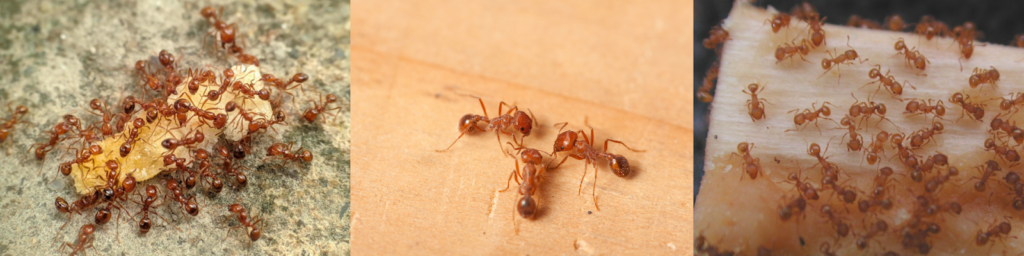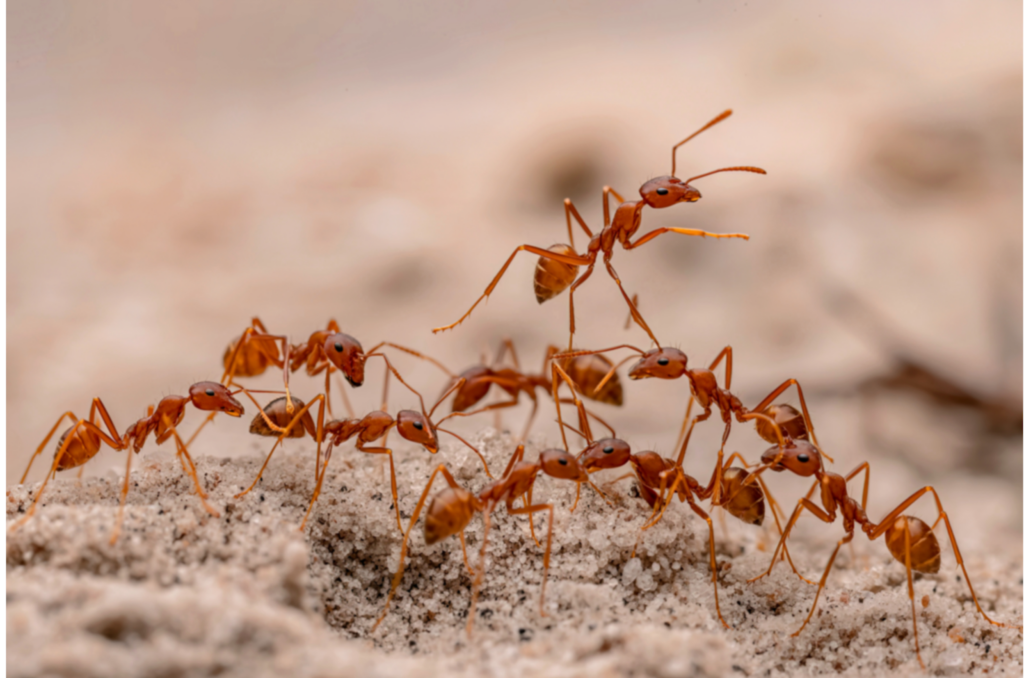

We’ve seen it happen more times than we can count: a homeowner spots red ants in their yard, assumes they’re fire ants, grabs something off the shelf, and within weeks the problem is dramatically worse. Not every red ant is a fire ant — and treating the wrong species with the wrong product can trap colonies inside your home, scatter them across your property, or simply do nothing at all.
Identifying the exact species before taking any action is step one, every single time. This guide covers the most common different types of red ants we have found in the Fort Myers, Naples, Cape Coral, and Orlando areas, what makes each one unique, and why getting the identification right matters more than any product you’ll find at a hardware store.
What Are the Different Types of Red Ants?
“Red ant” is a colloquial umbrella term, not a single species. Multiple ant species share a reddish or reddish-brown hue, which is exactly why misidentification runs rampant among homeowners.
Each one behaves differently, nests differently, and responds to completely different treatment approaches. Knowing which one you have changes everything.
In Florida, seven species come up regularly in our work:
| Species | Color | Size | Bite or Sting | Aggressiveness | Nest Type |
|---|---|---|---|---|---|
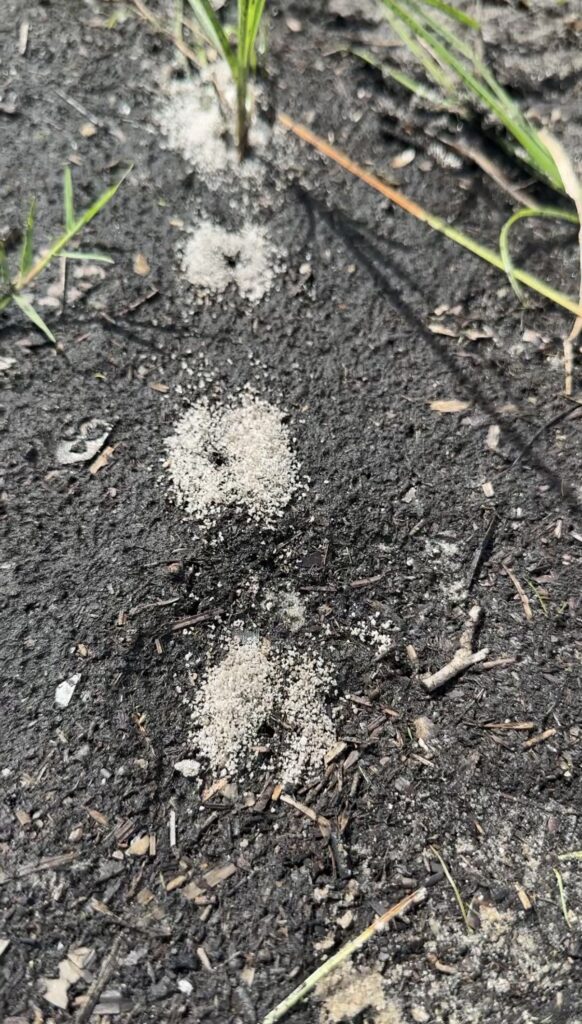
| Fire Ants | Reddish-brown to dark red | 1/8 – 3/8 in | Bites and stings | Highly aggressive — swarms instantly when disturbed | Dome-shaped dirt mound, no visible entry hole |
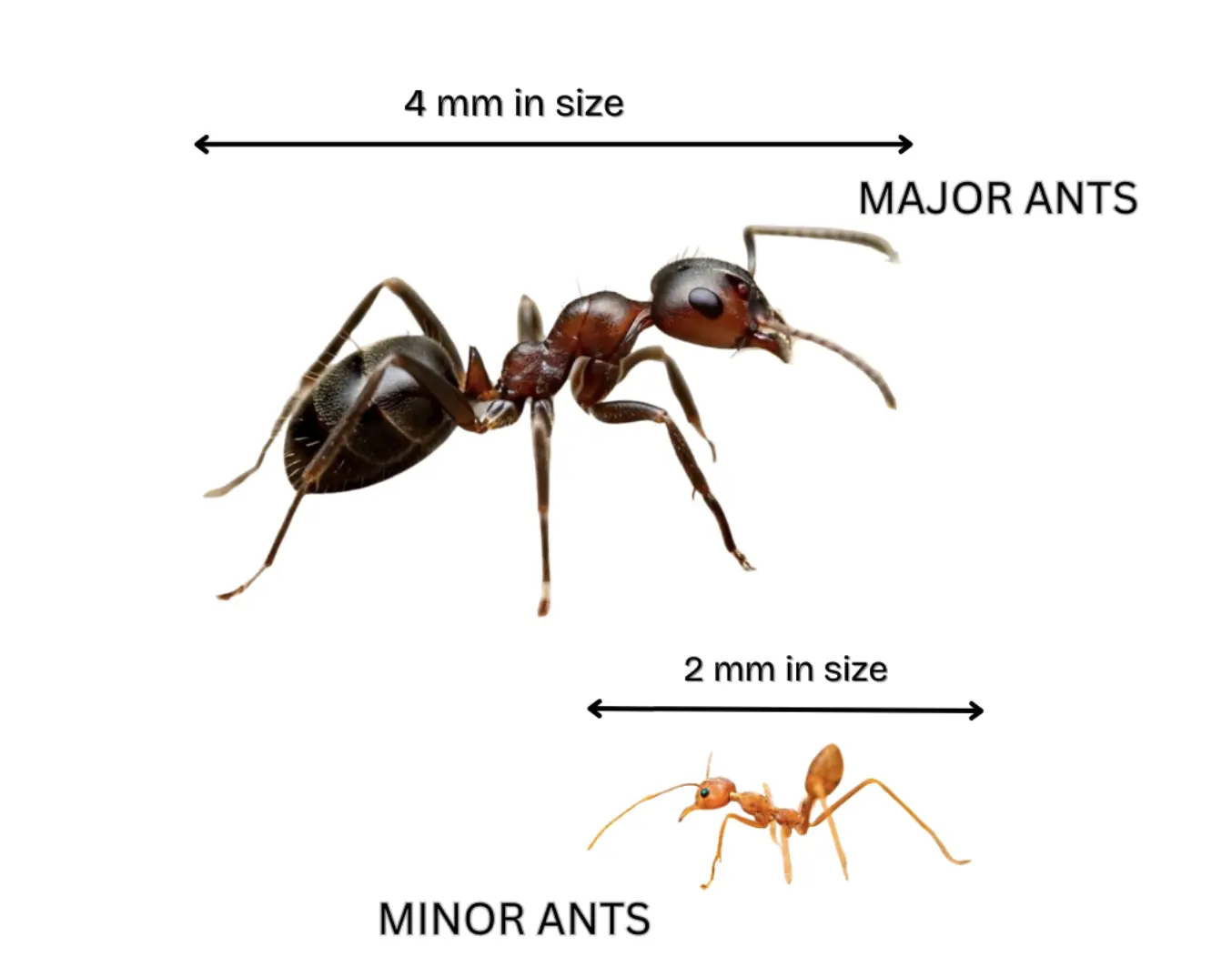
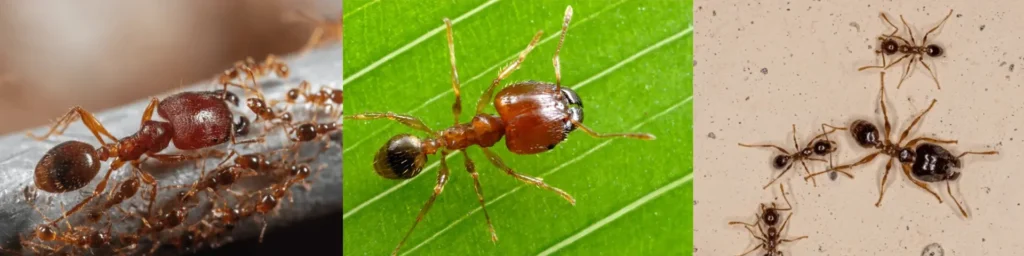
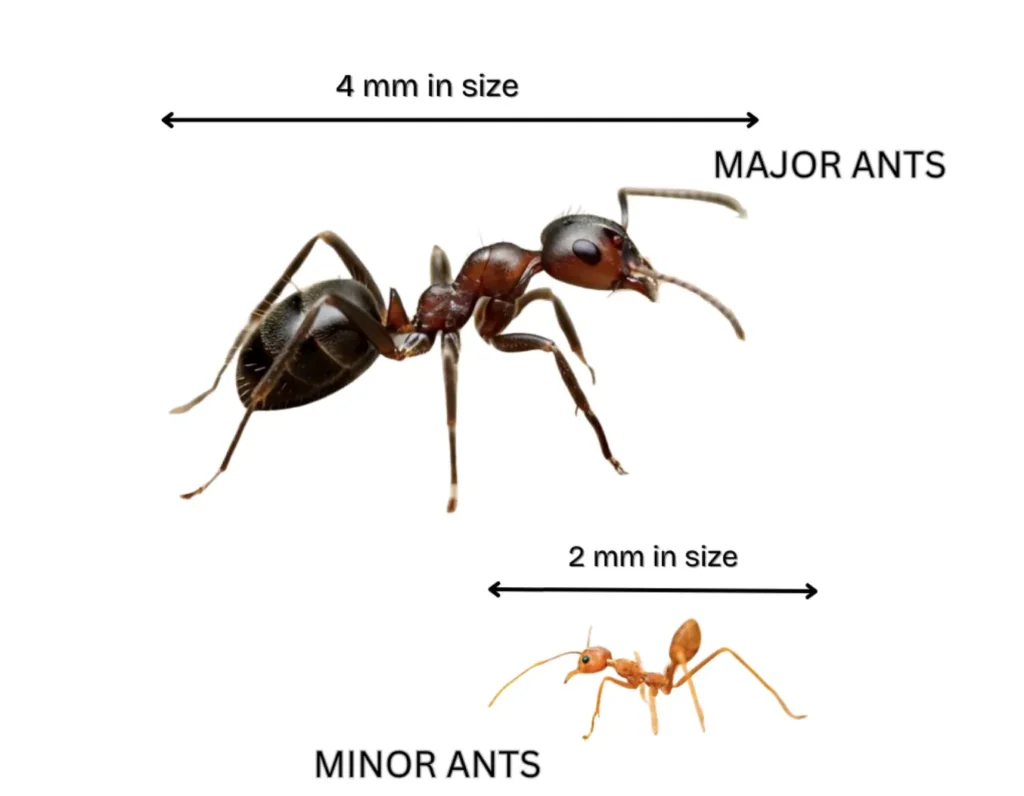
| Big-Headed Ants | Reddish-brown to black | Minors ~1/16 in; majors larger, oversized head | Bites only | Not aggressive to people, but colonies spread aggressively underground | Deep underground network extending into wall voids |
| Florida Harvester Ants | Bright reddish-orange | Up to 1/2 in | Stings (mild) | Low — won’t swarm unprovoked | Mound with a cleared, bare-dirt ring around it |
| Carpenter Ants | Reddish-black, or red head/thorax with black gaster | Up to 5/8 in | Bites only | Low to moderate toward people; high structural risk | Outdoor main nest (stump/log) + indoor satellite nests |
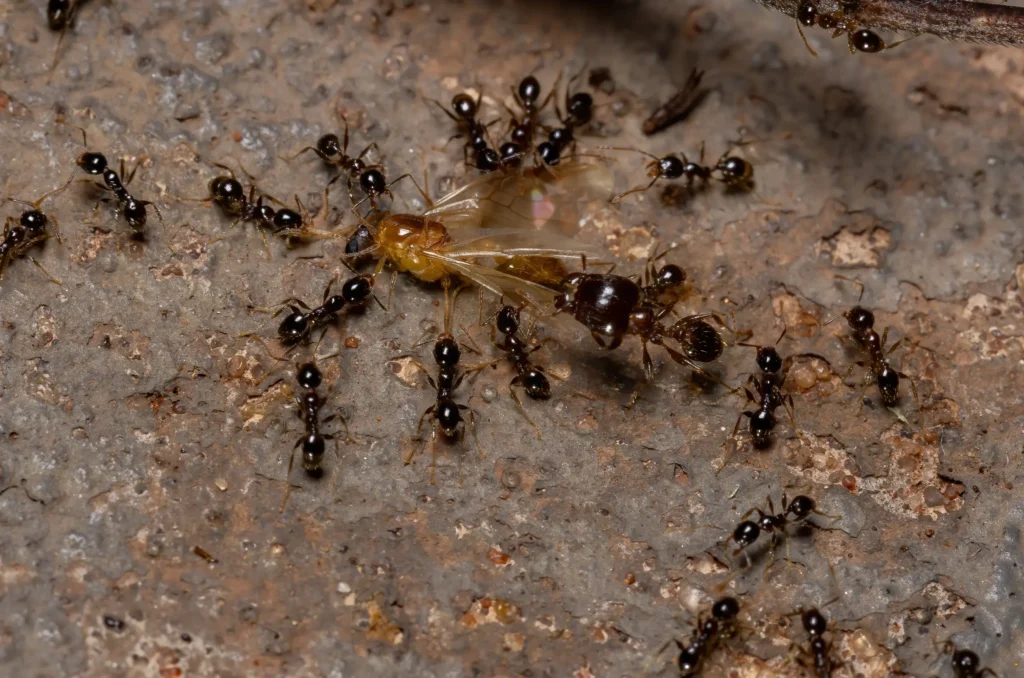
| Argentine Ants | Light to dark brown, slight reddish tint | ~1/8 in | Bites only (rare) | Low toward people; aggressively displaces native ants | Sprawling supercolonies, multiple queens |
| Pharaoh Ants | Pale yellowish to reddish | ~1/16 in | Negligible — contamination risk, not bite risk | Low, but splits into new colonies rapidly when threatened | Inside walls, outlets, insulation |
| Red Velvet Ants | Bright red/orange and black | Up to ~1 in | Stings only — not a true ant, it is a wasp | Not aggressive — stings only if handled or stepped on | None — solitary, no colony or nest |
Fire Ants: The Most Notorious Red Ant in the U.S.
Fire ants are among the most common infestations we deal with, and among the most critical to eliminate quickly.
Identification:
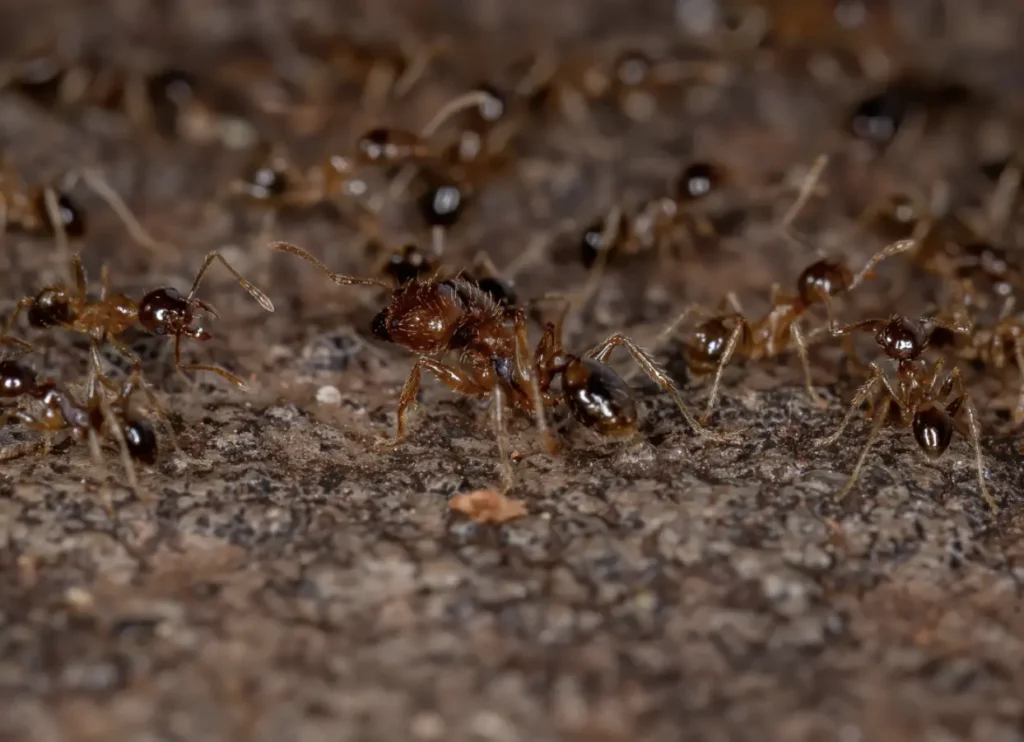
- Reddish-brown to dark red coloring
- Two nodes on the waist (pedicel)
- Size ranges from 1/8 to 3/8 inch
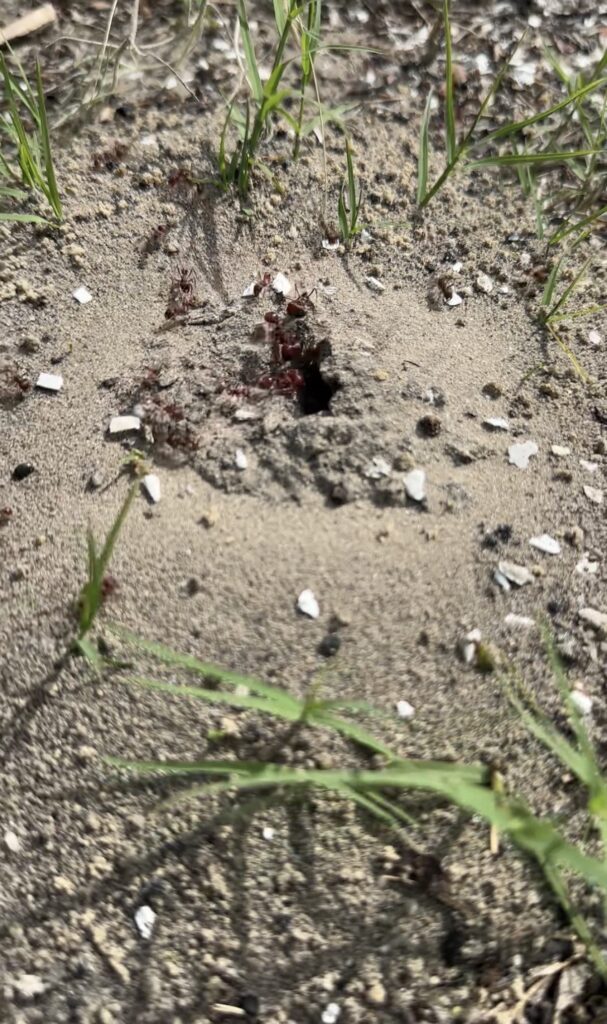
- Sand pile mounds with no visible entry hole on top — people often look for a hole and assume the mound isn’t active. It is.
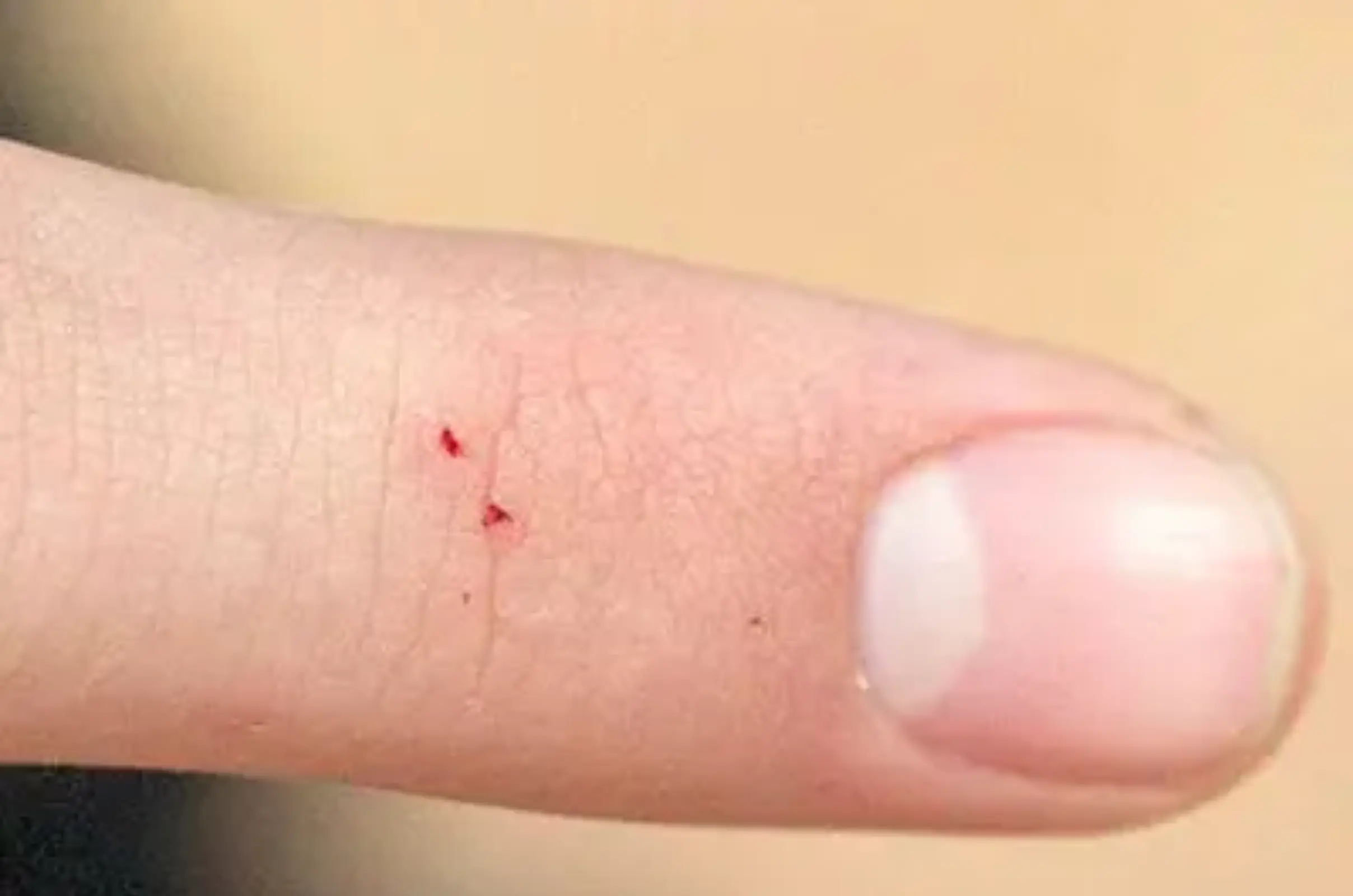
What makes fire ants uniquely dangerous is that they both bite and sting. They anchor into skin with their mandibles and inject venom repeatedly — different from other ant species, which only bite – example being big headed ants. For pets, small children, and anyone with a severe allergy, a disturbed colony can become a medical emergency within minutes. A mature colony can contain up to 500,000 workers, so disturbing a mound accidentally produces an immediate, aggressive response at enormous scale.
How to Tell Fire Ants Apart From Other Red Ants
Fire ants get misidentified constantly because other species share a similar red hue. Homeowners assume anything red and aggressive is a fire ant, buy the wrong product, and wonder why nothing worked.
The three key markers of fire ants:
- Two-node waist — visible under magnification
- Dome-shaped mound with no surface entry hole
- Aggressive swarming the instant the mound is disturbed
Harvester ants, carpenter ants, and pharaoh ants can all appear reddish and get lumped into the fire ant category by anyone not looking closely. Here’s why that mistake is costly: many over-the-counter products are repellent-based, designed to kill ants that are in contact with the product which pushes ants away from treated areas.
If you’re not certain what you’re dealing with, do not treat it yourself – call the professionals that can identify and customize a plan made for you.
Big-Headed Ants: Florida’s Fastest-Growing Ant Problem
If we had to name one species that’s become more problematic than it was five years ago, it’s the big-headed ant. The University of Florida IFAS is actively conducting studies to find effective solutions for this invasive species — which should tell you everything about the scale of the problem.
Identification:
- Disproportionately large head on the major worker caste
- Reddish-brown to black coloring
- Two distinct worker sizes (major and minor) within the same colony
Their supercolonies can extend property lines and connect across neighborhoods. They infiltrate homes through baseboards and establish themselves deep inside wall voids before you ever see a single ant on the surface.
Here’s the scenario we’ve watched backfire repeatedly: a homeowner identifies what they think are fire ants inside and outside their home, buys a repellent spray, and treats the exterior perimeter. What they’ve actually done is trap the indoor colony — part of the same massive network — inside the structure with nowhere to go. The infestation doesn’t improve. It explodes.
Big-headed ants require a heavy, targeted treatment protocol. Over-the-counter products can’t tame this species, and the wrong approach doesn’t just fail — it actively worsens the situation.
Florida Harvester Ants: The Red Ant Most People Overlook
Harvester ants are consistently overlooked — homeowners either don’t know they exist or immediately assume they’re fire ants.
Identification:
- Larger than fire ants — up to 1/2 inch long
- Bright reddish-orange coloring
- Circular nest mounds surrounded by a cleared ring of bare ground where they’ve removed all vegetation
That cleared vegetation ring is the most reliable visual distinguisher. Fire ants don’t do that.
Harvester ants forage primarily for seeds, not food scraps or proteins. Bait traps designed for omnivorous ants are often completely ineffective against them — which explains why homeowners who’ve put out bait sometimes see zero results. They’re less aggressive than fire ants and won’t swarm unprovoked, but “less aggressive” doesn’t mean the colony resolves itself without proper treatment.
If you see a bare dirt ring around a mound, don’t assume fire ants. Look closer before you act or contact us with a picture via text and we can help identify!
Carpenter Ants: The Red Ant That Damages Your Home’s Structure
Carpenter ants are among the largest species you’ll encounter — up to 5/8 inch long — and one we’ve seen cause real structural damage when left unaddressed.
Identification:
- Often reddish-black, or entirely red depending on the species
- Single node waist (not two nodes like fire ants)
- Smoothly rounded thorax
We had a customer convinced they had fire ants outside the home. When inspected, they were carpenter ants — and the situation was more serious than they’d realized. In Florida, carpenter ants often use a satellite colony system: the main nest with the queen stays outside in a rotting stump or fallen log, while satellite nests of workers establish inside walls, attics, and foam insulation.
This distinction completely changes the treatment plan. Treating only the exterior mound does nothing for the satellite nest inside, and treating only the interior doesn’t eliminate the queen driving new colony growth outside. Learning how to find hidden bugs in your home can help you spot early warning signs, but carpenter ants inside walls need a professional assessment to catch the full picture.
Argentine Ants and Pharaoh Ants: Smaller Species, Serious Problems
These two look less threatening than fire ants. That appearance is deceptive.
Argentine Ants:
- Light to dark brown with a slight reddish tint
- Form supercolonies with multiple queens spanning enormous areas
- Aggressively displace native ant species
- Highly resistant to standard over the counter baits — their colony structure allows them to split and relocate when threatened
Pharaoh Ants:
- Tiny — about 1/16 inch
- Pale yellowish to reddish coloring
- Nest inside walls, electrical outlets, and insulation
- Known to carry and transmit pathogens
Both species share one critical behavior: they “bud” when threatened by repellent treatments. Rather than dying, the colony fractures into multiple new colonies that spread throughout the structure. We’ve watched a manageable kitchen infestation turn into a building-wide crisis because someone sprayed a repellent and thought they were solving the problem. For a broader look at ant behavior and why identification matters, these 10 facts about ants are worth a read.
Red Velvet “Ants”: Not an Ant at all
Of everything on this list, red velvet ants cause the most confusion — because despite the name, and despite looking exactly like an oversized, fuzzy red ant, they’re not ants at all. They’re wasps.
Identification:
- Dense, velvety orange-red hair covering the thorax and abdomen
- Wingless females up to around an inch long — noticeably larger than any true ant on this list
- Winged males exist but are rarely seen; it’s almost always the wingless female that people spot
- No nest mound, no foraging trail, no visible colony structure of any kind
That last point is the one that actually matters for treatment. True ants — fire ants, big-headed ants, harvester ants — live in colonies with a queen, workers, and a nest you can eventually locate and treat. Red velvet ants don’t. Each female is solitary: she wanders the ground alone searching for the underground nests of other burrowing insects (most often ground-nesting bees) to lay her eggs in. There’s no colony to bait and no mound to treat, because there’s no “infestation” in the way the word usually gets used.
What there is, is a genuinely painful sting. Females carry one of the most potent stings of any insect in North America — it’s why they’ve earned the nickname “cow killer” (folklore, not fact; it won’t kill a cow). The sting is rarely medically dangerous without an allergy, but it’s intensely painful for 20 to 30 minutes, which is exactly why people call a pest control company the moment they spot one near the house.
Because there’s no colony or nest to treat, the right response to a red velvet ant sighting isn’t a bait or a perimeter spray aimed at “fire ants” — it’s giving it space. They’re not aggressive and only sting when stepped on, handled, or cornered. If you’re seeing them regularly in one area of the yard, it’s usually a sign of an active ground-nesting bee or wasp population nearby — worth having looked at, not because the velvet ant needs treating, but because that’s what’s drawing them in.
Why Do Red Ants Appear Suddenly?
Sudden red ant activity almost always has an environmental trigger:
- Heavy rain — drives fire ants and big-headed ants to the surface and toward structures
- Warm weather — accelerates colony expansion and foraging range
- Construction or landscaping — disrupts underground nests and forces colonies to relocate
By the time ants are visible inside your home, the colony has typically been established for weeks or months. Big-headed ants appearing at your baseboards didn’t arrive overnight — their network has been expanding underground long before you spotted a single worker. Indoor infestations are also driven by food sources, moisture, and structural entry points: cracks in the foundation, gaps around baseboards, utility line penetrations.
Are All Red Ants Harmful?
Not all different types of red ants pose the same risk — but they all pose some risk, and the nature of that risk varies by species:
- Fire ants: Most immediately dangerous. Venomous sting, aggressive swarming, medical risk for allergic individuals.
- Big-headed ants: Bite only, but their structural invasiveness and colony scale make them a serious property threat.
- Carpenter ants: Low medical risk, high structural risk. The damage happens inside walls where you can’t see it.
- Pharaoh ants: Minimal physical threat, but known pathogen carriers — a public health risk their small size completely masks.
- Argentine ants: Difficult to control once a supercolony is established; aggressively displace native species.
Physical harm, structural damage, and contamination are all on the table — depending on what you’re actually dealing with.
Why Misidentifying Red Ants Makes the Problem Worse
The most common mistake we see is reaching for an over the counter repellent spray. For budding species like pharaoh ants, Argentine ants, and big-headed ants, that triggers a split. One colony becomes three. Three becomes ten. By the time a homeowner calls me, what could have been a targeted treatment is now an ongoing program because the colony has fractured across the entire structure.
We see this cycle constantly: treat, activity slows, comes back worse, treat again, gets worse again. By the time we are involved, the timeline to resolution has tripled.
Professional identification combines physical characteristics, nesting behavior, and foraging pattern analysis — then applies solutions calibrated to the specific species that simply don’t have a comparable counterpart on any hardware store shelf. If you suspect any of the different types of red ants described here, get a professional identification before touching anything. For answers to common pest situations, browse the most common pest control questions we hear from homeowners.
The Bottom Line
Every species in this guide — fire ants, big-headed ants, harvester ants, carpenter ants, Argentine ants, pharaoh ants, and red velvet ants — requires a different strategy. Treating them all the same is the fastest way to make your infestation worse.
If you’re in Florida and seeing red ants, don’t guess. Get the species confirmed by a licensed pest control professional, and build your treatment plan from there.
Our Orlando Service Locations:
- Orlando
- Clermont
- Apopka
- Windermere
- St. Cloud
- Winter Garden
- Lake Buena Vista
- Kissimmee
- Sanford
- Davenport
- Oakland
- Minneola
- Lake Nona
- Ocoee
- Longwood
- Lake Mary
- Oviedo
- Winter Park
- Altamonte Springs
Our Southwest, FL Service Locations:
- Fort Myers
- Cape Coral
- Naples
- Babcock Ranch
- Lehigh Acres
- Ave Maria
- Estero
- Bonita Springs
- Marco Island
- Sanibel Island