
What They Are, How to Treat Them, and Why You Shouldn’t Go It Alone
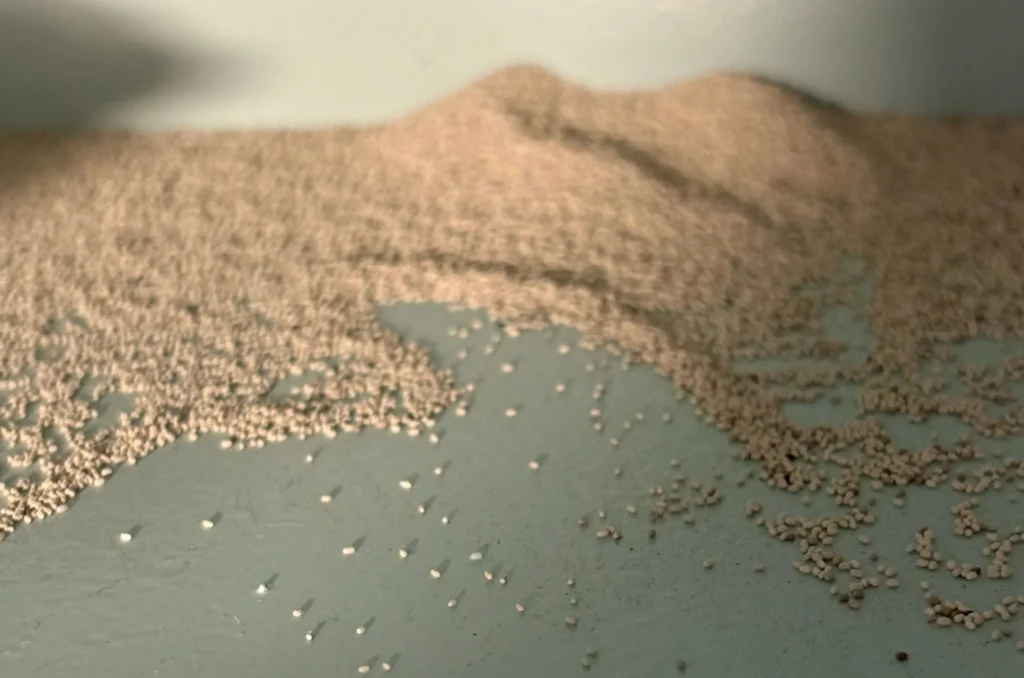
Have you spotted small piles of, what look like, sawdust near baseboards or window frames? Ever found paper like wings scattered around the residence after a warm night? The answer could be drywood termites. In Florida, these pests are a growing concern — and at Infinite Pest Solutions, we’re seeing demand for control climb every year.
This guide covers everything you need to know: what drywood termites actually are, how they’re treated, what you can do to prevent them, and why handling it yourself is a risk not worth taking.
What Are Drywood Termites?
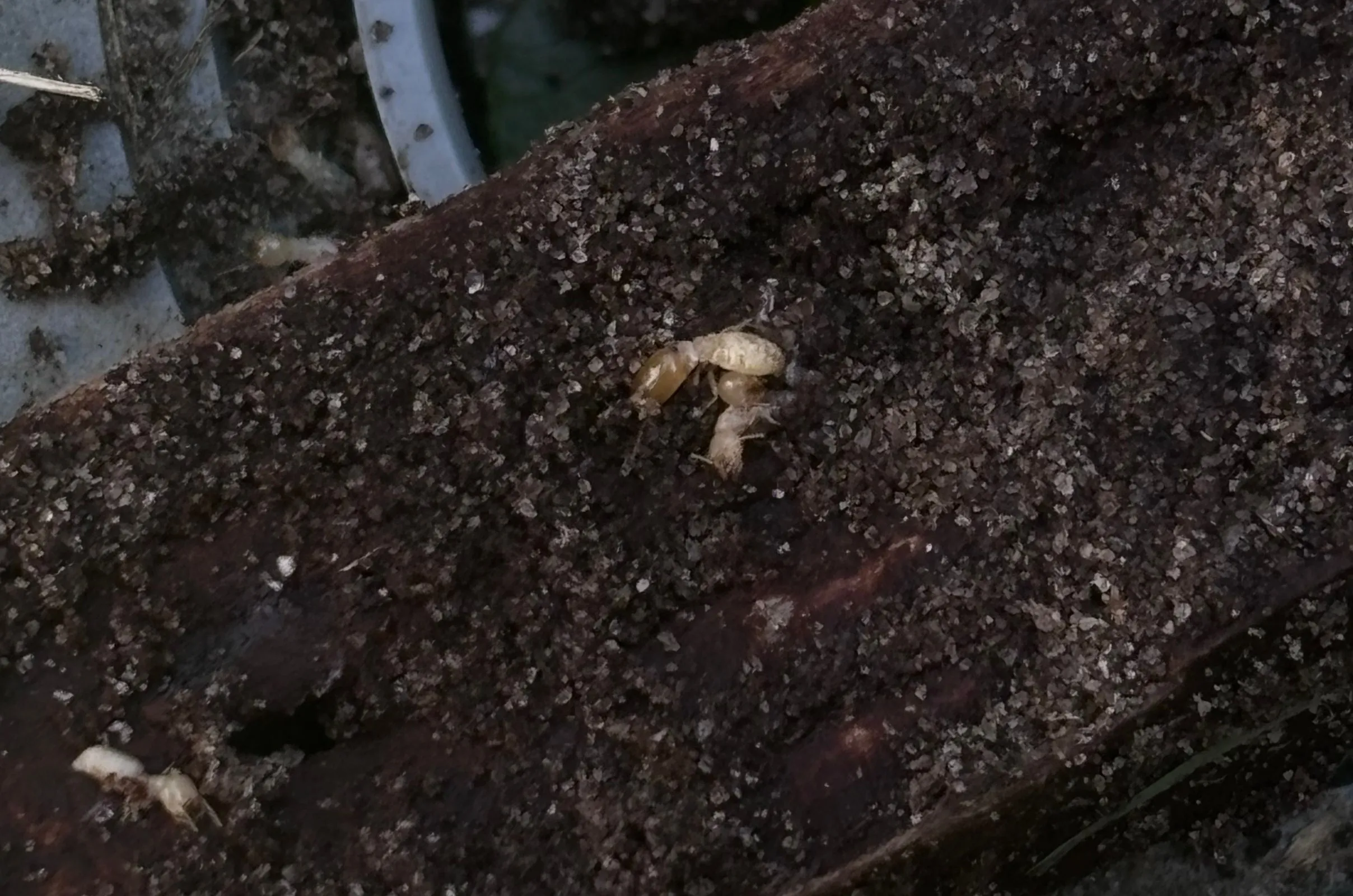
Drywood termites are a species of termite that lives entirely within the wood they infest — no soil contact required. Unlike subterranean termites, which need moisture and travel through the ground to reach a structure, drywood termites set up colonies directly inside dry wood: your wall studs, door frames, window frames, attic trusses, furniture, and more.
One of the most important things to understand about drywood termites is how they compare to their subterranean cousins:
They move slower — but they spread wider. Subterranean termites typically operate as one large colony moving through soil. Drywood termites move more slowly through a structure, but they can establish multiple colonies in different areas of the same home simultaneously. That means while the damage may develop more gradually, you can have infestations in several locations at once without knowing it.
They don’t need moisture to survive. Drywood termites extract the water they need directly from the wood they eat, which means no leaky pipes or damp conditions are required. That said, moisture-damaged wood — from a slow roof leak, plumbing issue, or poor drainage — can make wood softer and more attractive to them, so addressing moisture problems in and around your home still matters.
The signs are subtle until they’re not. The most common indicators of a drywood termite infestation include:
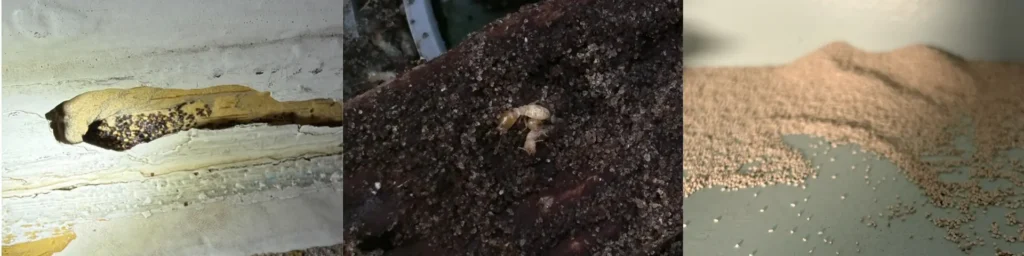
- Frass — tiny, pellet-shaped droppings they kick out of the wood (also called kick-outs)
- Exit holes — small, round holes in wood surfaces where frass is pushed out
- Swarmers and discarded wings — reproductive termites that emerge in warm months to start new colonies
- Hollow-sounding wood – when tapped
A Real Look at How Bad It Can Get
To understand why drywood termites deserve serious attention, consider a home we recently treated. The homeowner had noticed swarmers and discarded wings on the second floor. When we came out for a free inspection, we found:
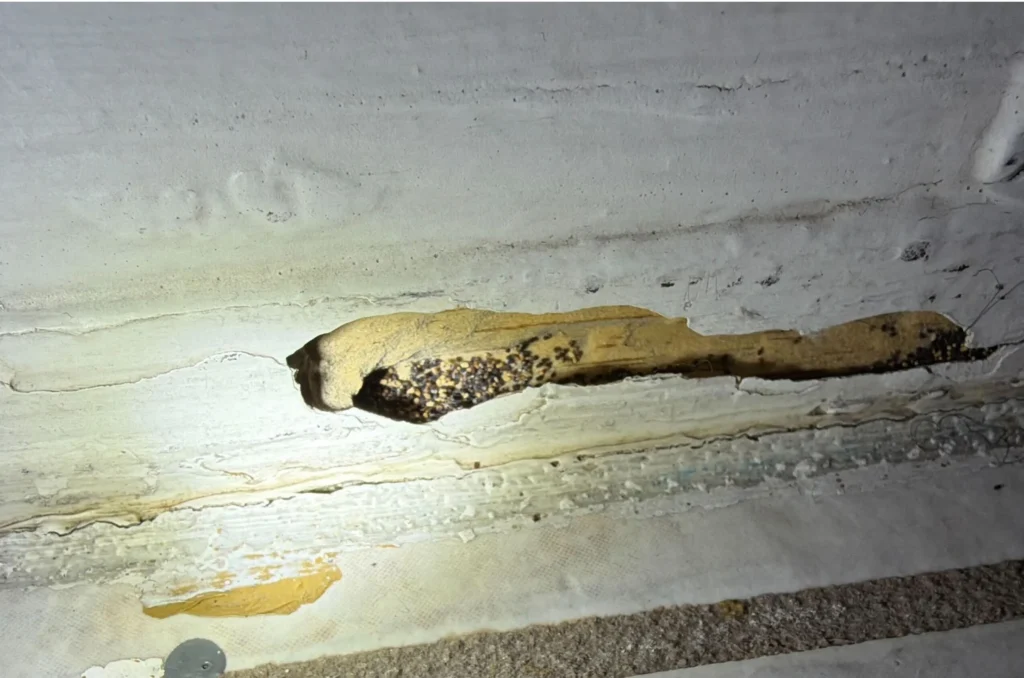
Exit holes and frass in window frames, door frames, baseboards, and closet door frames throughout the second floor — and mirroring activity on the first floor on the same side of the house. The built-in entertainment center in the living room showed significant activity. Upstairs in the attic, we found widespread infestation, which was riddled with so many kick-out holes it looked like a piece of swiss cheese.
The homeowner chose our liquid no-tent treatment over fumigation. During the treatment, our technician discovered additional infestation throughout the first floor attic as well — areas that showed no obvious signs from inside the home. Since treatment began, we’ve returned to re-treat the entertainment center, where the disturbance caused the termites to create new kick-out holes as they moved within the wood.
This is what a drywood termite infestation actually looks like. It’s rarely just one spot. It spreads quietly, through multiple areas, over time — and by the time the signs are obvious, the infestation is already well-established.
How to Treat Drywood Termites
When it comes to treatment, there are two main options: liquid no-tent treatment and fumigation (tenting). Both are effective — but they work differently, and the right choice depends on the extent of the infestation and your situation.
Liquid No-Tent Treatment
This is the method we most commonly recommend, and it’s grown significantly in demand. Here’s how it works: our licensed technician treats the wood directly including door and window frames, and exposed wood in the attic. The key advantage of no-tent treatment is residual protection for years to come. We also offer a monthly warranty option with no-tent treatments, giving homeowners ongoing peace of mind.
No-tent treatment is also considerably less invasive and less expensive than fumigation. You don’t have to leave your home. You don’t have to move furniture or appliances. Life keeps going.
Fumigation (Tenting)
Fumigation involves sealing the entire structure under a tent and introducing a treatment that penetrates every inch of the home, killing termites on contact. It’s highly effective for the termites that are present— especially for severe, widespread infestations — and we offer tenting services in our Southwest Florida locations.
The trade-off is the inconvenience and cost. You’ll need to vacate the home and stay in a hotel until the structure is cleared — typically a few days. Large appliances like refrigerators, along with furniture and other belongings, need to be relocated or properly prepared. It requires significant planning and expense.
Critically, fumigation provides no residual protection. Once the treatment is complete, the structure has no ongoing defense against new swarmers. There is no warranty component the way there is with liquid treatment.
Our honest take: For most homeowners, the liquid no-tent treatment is the better option — it’s more affordable, far less disruptive, and actually offers better long-term protection through its residual and warranty coverage. Fumigation is the right call for severe, whole-structure infestations where the scope and extent of the problem warrants it.
At Infinite Pest Solutions, we inspect every property for free and give you a clear, honest recommendation based on what we actually find — not what’s easiest or most profitable for us.
How to Get Rid of Drywood Termites Without Tenting
The good news is that tenting is not your only option. Our whole-home liquid no-tent treatment is specifically designed to eliminate drywood termites from an entire structure without the disruption and cost of fumigation.
Here’s what the process looks like:
- Free inspection — we assess the full structure, identifying all areas of activity
- Customized treatment plan — based on the inspection, we map out the full scope of treatment needed
- Targeted application — we treat appropriately for the specific areas identified
- Follow-up — we return as needed to re-treat active areas and monitor progress
- Warranty coverage — ongoing monthly warranty protection to keep your home covered
We offer this service at both our Southwest Florida locations (Fort Myers, Naples, Marco Island, Cape Coral) and our Central Florida locations (Orlando, Clermont, Apopka).
Why You Shouldn’t Try to Treat Drywood Termites Yourself
We understand the appeal of handling it yourself. You can find products online, and it feels like it should be straightforward. But DIY drywood termite treatment consistently falls short — and here’s why.
The product isn’t the problem — the application is. Professional-grade products are effective when used correctly. But homeowners who get their hands on over-the-counter versions typically make the same critical mistakes:
- Spraying broadly instead of treating the galleries. Drywood termites live inside the wood. Spraying the surface does almost nothing. Treatment has to be injected directly into the galleries — the tunnels termites have carved inside the wood — to reach the colony.
- Overtreating the wrong areas while undertreating the right ones. Without knowing what to look for or where to look, it’s easy to apply a lot of product in the wrong places and miss the actual infestation entirely.
- Missing infested areas altogether. This is perhaps the biggest issue. A trained inspector knows where drywood termites hide — attic trusses, hatch frames, inside wall voids, within built-in cabinetry. Homeowners typically treat what they can see and leave the rest untouched, allowing the infestation to continue and expand.
A licensed technician comes out, does a thorough free inspection, identifies every area of concern, and then applies EPA-registered solutions to exactly the right places in exactly the right way. That’s not something a can from the hardware store can replicate.
How to Prevent Drywood Termites in Florida
Prevention is always better — and cheaper — than treatment. Here’s what we recommend:
Get an annual termite inspection. This is the single most important thing you can do. A professional can spot early signs of activity — frass, exit holes, subtle wood damage — long before an infestation becomes serious. Catching it early means simpler, less expensive treatment.
Do preventative drywood treatments. For homes in Florida, we strongly recommend proactive treatment of high-risk areas: attic spaces, window frames, door frames. This is far more cost-effective than waiting for an infestation to develop.
Address moisture and leaky pipes. While drywood termites don’t require moisture to survive, wood that has been softened or damaged by moisture is more attractive and easier for them to establish in. Fixing leaky pipes, addressing roof leaks, and keeping moisture away from the structure reduces your overall vulnerability.
Seal entry points. Cracks, gaps around window frames, and exposed wood on the exterior of the home give swarmers easy access. Regular maintenance and sealing these areas helps reduce the risk of new colonies getting started.
Florida’s climate — warm, humid, and with long active seasons for swarmers — makes drywood termite pressure a year-round reality. Proactive prevention is simply part of responsible homeownership here.
Ready for a Free Inspection?
Whether you’ve spotted the signs of drywood termites or just want peace of mind, Infinite Pest Solutions offers free inspections at residential and commercial properties throughout Southwest Florida and Central Florida. We’ll assess the full structure, tell you exactly what we find, and give you a clear plan to address it — no pressure, no guesswork.
Our Orlando Service Locations:
- Orlando
- Clermont
- Apopka
- Windermere
- St. Cloud
- Winter Garden
- Lake Buena Vista
- Kissimmee
- Sanford
- Davenport
- Oakland
- Minneola
- Lake Nona
- Ocoee
- Longwood
- Lake Mary
- Oviedo
- Winter Park
- Altamonte Springs
Our Southwest, FL Service Locations:
- Fort Myers
- Cape Coral
- Naples
- Babcock Ranch
- Lehigh Acres
- Ave Maria
- Estero
- Bonita Springs
- Marco Island
- Sanibel Island