

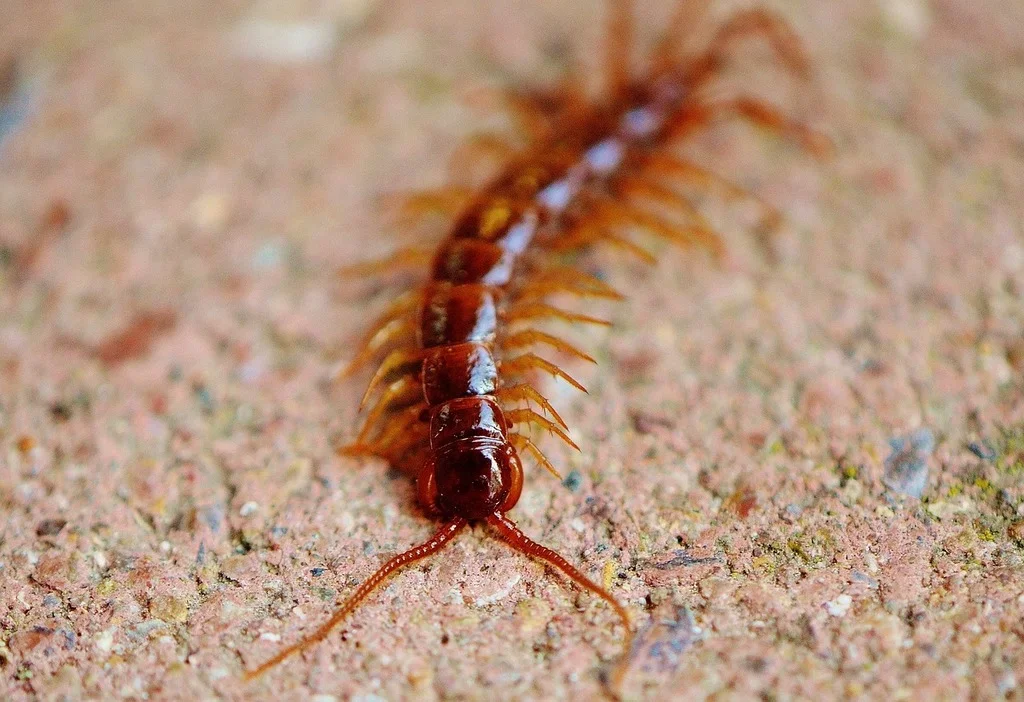
Centipedes
Centipede Profile
| Feature | Details |
| Scientific Name | Scutigera coleoptrata (House Centipede) & Scolopendra spp. |
| Size | 1 inch (House Centipede) up to 6+ inches (Large Florida Centipede) |
| Other Names | Hundred-leggers, Florida Blue Centipede |
Key Identification
Centipedes are often confused with millipedes, but they have very different habits and appearances.
- Legs: Centipedes have one pair of legs per body segment, which stick out from the sides of their bodies. Millipedes have two pairs per segment and look more like “tubes.”
- Speed: Centipedes are lightning-fast predators. If it scurries quickly across the floor when you flip on a light, it’s a centipede.
- Body Shape: They are flattened horizontally, allowing them to squeeze into incredibly tight cracks under baseboards or door sweeps.
- The “Fangs”: They have a pair of modified front legs (forcipules) that act like venomous claws to paralyze their prey.
About Centipedes in Florida
In Florida, homeowners usually encounter two types: the leggy, feather-like House Centipede (which stays indoors and hunts roaches) and the larger, more intimidating Florida Blue or Giant Centipede (which typically lives outdoors but wanders in during heavy rains).
Centipedes are “generalist predators.” They don’t eat your food or your house—they eat other pests. However, their appearance and the fact that larger species can deliver a painful bite make them unwelcome guests in any Florida home.
How to Treat
To get rid of centipedes, you have to remove their “buffet.” If there are no bugs to eat, the centipedes will leave or starve.
- General Pest Control: Since centipedes eat spiders, roaches, and silverfish, our standard ongoing pest service is the most effective treatment. When the food source disappears, so do the centipedes.
- Dehumidification: Centipedes have a high rate of water loss and must stay in moist environments. Using dehumidifiers in crawlspaces or damp Florida garages makes your home inhospitable to them.
- Exclusion: We focus on sealing the “low-level” entry points. Centipedes enter under doors with worn sweeps and through gaps in the “weep holes” of brick homes.
- Exterior Perimeter Barrier: We apply a residual liquid barrier around the foundation and in mulch beds to stop larger outdoor species from migrating toward your porch or patio.
Frequently Ask Questions About Centipedes in Florida
Are Florida centipedes dangerous?
Most house centipedes are harmless and cannot break human skin. However, larger Florida species (like the Giant Centipede) can bite if handled. The bite is often compared to a bee sting—painful and causing some swelling, but generally not life-threatening unless you have an allergy.
Why am I suddenly seeing centipedes in my bathroom?
Centipedes are highly attracted to moisture. In Florida, they often emerge from drains or hide under bathroom vanities because the humidity levels are highest there. It may also indicate a small leak or a silverfish population in the walls.
Do centipedes travel in pairs or groups?
No, centipedes are solitary hunters. If you see multiple centipedes, it doesn’t mean they are “nesting” together; it means your home has an abundant food source (other insects) supporting a high population of individual hunters.
Our Orlando Service Locations:
- Orlando
- Clermont
- Apopka
- Windermere
- St. Cloud
- Winter Garden
- Lake Buena Vista
- Kissimmee
- Sanford
- Davenport
- Oakland
- Minneola
- Lake Nona
- Ocoee
- Longwood
- Lake Mary
- Oviedo
- Winter Park
- Altamonte Springs
Our Southwest, FL Service Locations:
- Fort Myers
- Cape Coral
- Naples
- Babcock Ranch
- Lehigh Acres
- Ave Maria
- Estero
- Bonita Springs
- Marco Island
- Sanibel Island