
Ghost Ants
Ghost Ant Profile
| Feature | Details |
| Scientific Name | Tapinoma melanocephalum |
| Size | Microscopic: 1.3mm to 1.5mm |
| Other Names | “Sugar” ants, Phantom ants |
Key Identification
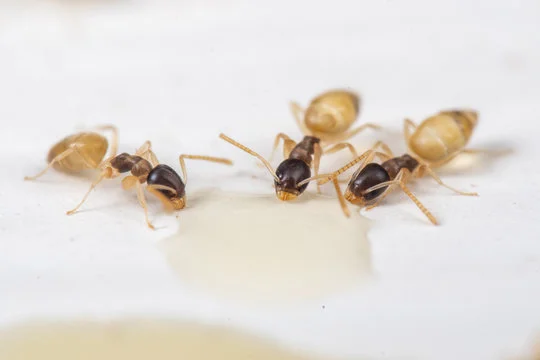
Ghost ants are so small they are often mistaken for moving dust particles until you look closely.
- The “Invisible” Look: They have a dark head and thorax, but their abdomen and legs are translucent (clear/white). Against a light-colored Florida countertop, they are nearly impossible to see.
- The Scent: When crushed, they emit a faint, rotten coconut-like odor (similar to the Odorous House Ant).
- Erratic Movement: They don’t usually travel in nice, straight lines. They scurry quickly and change direction constantly, making them hard to track.
- Location: They love moisture. In Florida, they are common in bathrooms, kitchens (near sinks), and even inside the soil of potted indoor plants.
About Ghost Ants in Florida
Ghost ants are a tropical species that cannot survive outdoors in colder climates, which is why they thrive year-round in Florida. They are multi-queen (polygynous) and practice “budding,” where part of the colony splits off to form a new nest if they feel threatened.
They are highly attracted to sweets—soda spills, syrup, and even the honeydew from aphids on your patio plants. Because they are so small, they can nest in the strangest places: inside curtain rods, behind baseboards, and even inside electrical outlets or laptop keyboards.
How to Treat
If you spray Ghost Ants with a typical “ant killer” from a big-box store, you will likely trigger budding, turning one small problem into five different nests throughout your house.
- Professional Pest Control: We use specialized residuals and clear gel baits. The ants cannot detect these, and will consume the sugar-rich bait, or pick up the residuals on their legs and bodies, carrying them back to the multiple queens to collapse the entire colony.
- Exterior Perimeter Check: We inspect your Florida landscaping. Ghost ants often move from the “honeydew” sources on your bushes into your home. In addition to treating the perimeter of the home with a non-repellent residual, treating the shrubs and trees is often the “missing link” in ghost ant control.
- Moisture Control: We identify and help you address small leaks or high-humidity areas. If a bathroom stays damp, Ghost Ants will never want to leave.
Frequently Asked Questions About Ghost Ants
Why do Ghost Ants keep coming back to my kitchen?
Ghost ants are masters of “satellite nesting.” If you only treat the ants you see on the counter, the queens hidden behind the wall will simply produce more workers or move the nest to a new location. Professional baiting is required to reach the source.
Are Ghost Ants dangerous?
They do not sting and their bite is generally too small to be felt by humans. However, because they frequent sinks and trash cans, they can mechanically transfer bacteria to your food and food-preparation surfaces.
How did Ghost Ants get into my house?
In Florida, they usually enter through branches touching the roof, gaps in window screens, or even via new indoor plants brought from a nursery. Because they are so tiny, a gap the size of a needle is enough for them to enter.
Our Orlando Service Locations:
- Orlando
- Clermont
- Apopka
- Windermere
- St. Cloud
- Winter Garden
- Lake Buena Vista
- Kissimmee
- Sanford
- Davenport
- Oakland
- Minneola
- Lake Nona
- Ocoee
- Longwood
- Lake Mary
- Oviedo
- Winter Park
- Altamonte Springs
Our Southwest, FL Service Locations:
- Fort Myers
- Cape Coral
- Naples
- Babcock Ranch
- Lehigh Acres
- Ave Maria
- Estero
- Bonita Springs
- Marco Island
- Sanibel Island