

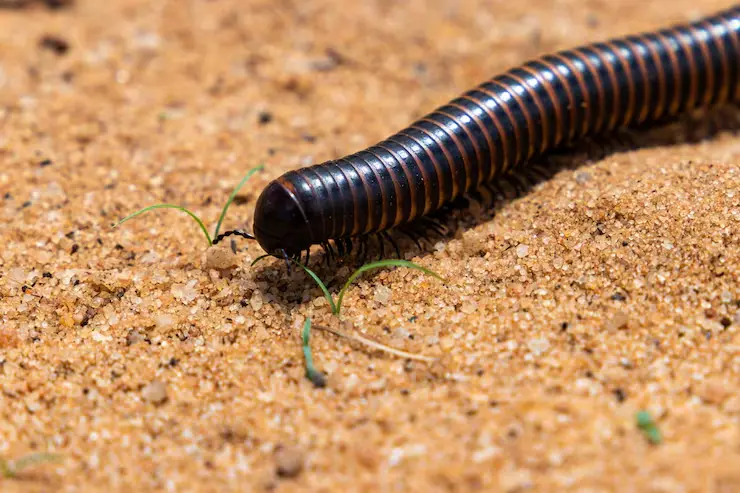
Millipedes
Millipede Profile
| Feature | Details |
| Scientific Name | Class Diplopoda (notably the Yellow-Banded Millipede) |
| Size | 1 to 4 inches depending on the species |
| Diet | Decaying organic matter (mulch, leaves, damp wood) |
Key Identification
Millipedes are often confused with centipedes, but they have very different body structures and temperaments.
- The “Leggy” Look: Millipedes have two pairs of legs per body segment. Their legs are tucked under their bodies, unlike centipede legs which stick out the sides.
- The Defense Curl: When threatened or dead, millipedes almost always curl into a tight, spiral “C” shape.
- Slow Movement: Unlike the lightning-fast centipede, millipedes move in a slow, rhythmic “wave” motion.
- Coloration: In Florida, you’ll frequently see the Yellow-Banded Millipede, which is dark brown or black with bright yellow or orange stripes on each segment.
About Millipedes in Florida
Millipedes are “recyclers.” They live in the moist soil and mulch surrounding Florida homes, eating dead leaves and organic debris. They are vital to the ecosystem, but they are highly sensitive to moisture levels.
In Florida, two things trigger a millipede invasion: too much rain or too much drought. Heavy rain floods their subterranean tunnels, forcing them to crawl upward (often into your house). Extreme drought dries out the mulch, forcing them to seek the cool, damp environment of your foundation or garage.
How to Treat
Millipedes do not survive long indoors (usually only 24–48 hours) because the air is too dry. Therefore, Pest Control focuses on the exterior perimeter.
- Mulch Management: This is the #1 prevention step. If mulch is too thick (over 3 inches), it traps moisture and creates a “millipede factory.” We recommend keeping mulch thin and away from the direct foundation.
- Perimeter Granular Barrier: We apply water-activated granules around the perimeter of the home. These are designed to withstand Florida’s heavy rains and kill millipedes before they reach the walls.
- The “Dry Zone”: We suggest homeowners maintain a 12-inch “dry zone” of gravel or bare dirt between the lawn and the home’s foundation to act as a natural deterrent.
- Entry Point Sealing: Millipedes are low-crawlers. Be sure you focus on sealing the gaps under garage doors and front door sweeps, which are their primary “highways” into the home.
Frequently Asked Questions About Millipedes
Do millipedes bite or sting?
No. Millipedes do not have stingers or fangs. They are completely docile. Their only defense is their hard exoskeleton and a smelly secretion they release to discourage birds and lizards from eating them.
Why do I find so many dead, curled-up millipedes in my house?
Millipedes require high humidity to breathe. Once they enter your air-conditioned Florida home, the air is too dry for them. They dehydrate quickly, curl up, and die—usually within a day of entering.
Are they poisonous to my pets?
They are not venomous, but some species release a “cyanide-like” defensive fluid that can be irritating if a dog or cat tries to eat them. It may cause your pet to drool or have a mild upset stomach, but it is rarely a medical emergency.
Our Orlando Service Locations:
- Orlando
- Clermont
- Apopka
- Windermere
- St. Cloud
- Winter Garden
- Lake Buena Vista
- Kissimmee
- Sanford
- Davenport
- Oakland
- Minneola
- Lake Nona
- Ocoee
- Longwood
- Lake Mary
- Oviedo
- Winter Park
- Altamonte Springs
Our Southwest, FL Service Locations:
- Fort Myers
- Cape Coral
- Naples
- Babcock Ranch
- Lehigh Acres
- Ave Maria
- Estero
- Bonita Springs
- Marco Island
- Sanibel Island