
Big Headed Ants
Big Headed Ants in Central and South Florida
| Feature | Details |
| Scientific Name | Pheidole megacephala (most common species) |
| Size | Workers: 2mm |
| Other Names | BHA, Pheidole ants |
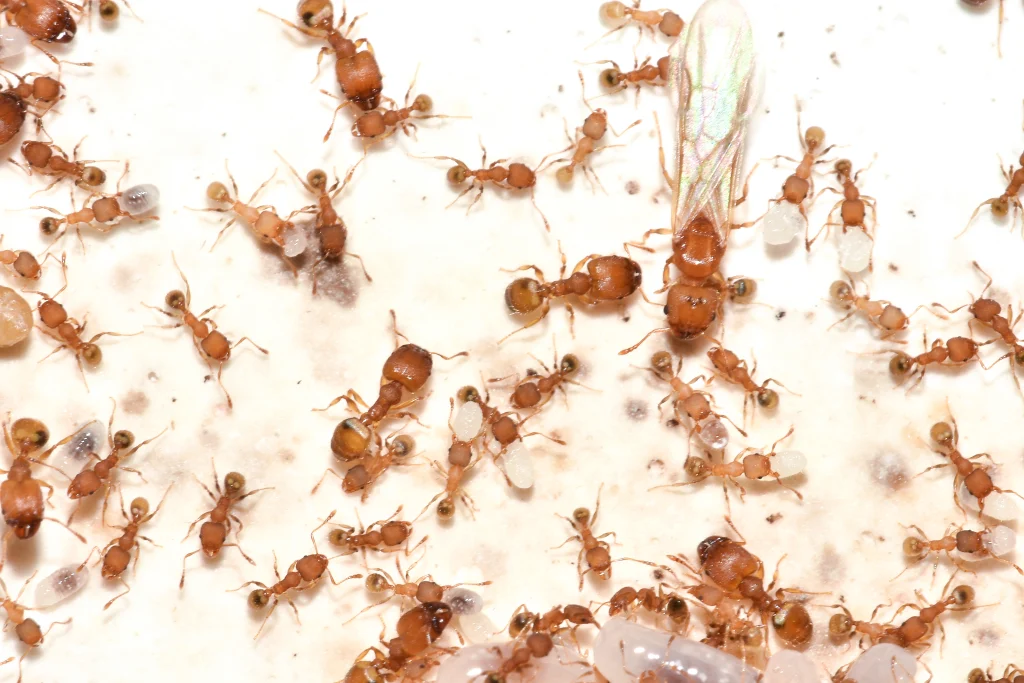
Big-headed ants (Pheidole) are a fascinating but frustrating invasive species. They are especially noticed for their two distinct different sizes – the major worker having an oversized head and the minor worker having a smaller normal ant looking body.
Key Identification
The defining characteristic of this species is their dimorphism—having two distinct types of workers.
- The “Major” Workers (Soldiers): They have oversized, heart-shaped heads that are disproportionately large compared to their bodies. These heads house massive muscles used for cracking open seeds or defending the nest.
- The “Minor” Workers: These are much smaller and look like your average small brown ant.
- The Trails: You will almost always see both sizes traveling together in the same trail, which is a dead giveaway for this species.
- No Odor: Unlike the odorous house ant, these do not have a strong scent when crushed.
- Mounds: Mounds will be mostly flat with multiple openings, or an open trench-like with the ants trailing through the trench.
- Indoors: It is common to see piles of sand or dirt with pieces of dead ants, coming out from under the baseboards.
About Big-Headed Ants
Big-headed ants are considered one of the world’s worst invasive species. They are super-colonial, meaning different nests don’t fight each other; instead, they link up to create massive “supercolonies” that can take over entire yards. The main colony can be up to a mile and a half away from where the ants are being seen.
They are highly attracted to proteins and fats (like insects or grease) but will also feed on honeydew produced by aphids. They are notorious for displacing native ant species and can even damage electrical equipment or irrigation systems by nesting inside them.
How to Treat
Because they form supercolonies and ability to have a colony for multiple blocks, a “spot treatment” will not get rid of the issue. You must think about the entire perimeter. Professional intervention is necessary:
- Perimeter Protection: Protection around the perimeter of the home by a licensed professional at Infinite is the best way to start protecting your home.
- Ongoing Treatment: It is most effective for ongoing pest treatments to control the issue.
Frequently Asked Questions on Big Headed Ants
Why do some of these ants have such big heads?
The “Major” workers have large heads to accommodate powerful mandibles. Their primary job is to protect the colony and use their strong jaws to crush hard food items like seeds or the shells of other insects.
Where do big-headed ants typically nest?
They prefer nesting in soil, often under rocks, pavers, or logs. Indoors, they may nest in wall voids or near base boards as they will infiltrate the home through these areas.
Can big-headed ants damage my house?
While they don’t eat wood like carpenter ants, they are known to “excavate” soil from under slabs and pavers, which can lead to sinking or uneven surfaces. They also occasionally chew through telephone or electrical insulation.
Our Orlando Service Locations:
- Orlando
- Clermont
- Apopka
- Windermere
- St. Cloud
- Winter Garden
- Lake Buena Vista
- Kissimmee
- Sanford
- Davenport
- Oakland
- Minneola
- Lake Nona
- Ocoee
- Longwood
- Lake Mary
- Oviedo
- Winter Park
- Altamonte Springs
Our Southwest, FL Service Locations:
- Fort Myers
- Cape Coral
- Naples
- Babcock Ranch
- Lehigh Acres
- Ave Maria
- Estero
- Bonita Springs
- Marco Island
- Sanibel Island