

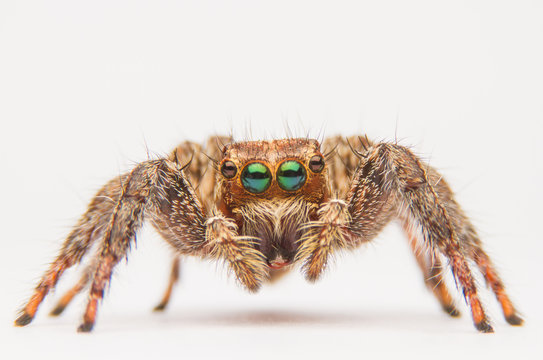
Jumping Spiders
Jumping Spider Profile
| Feature | Details |
| Scientific Name | Phidippus regius (Regal Jumping Spider) & others |
| Size | 10mm to 20mm (small but stocky) |
| Diet | Flies, moths, and even other spiders |
Key Identification
Jumping spiders are the easiest spiders to identify because of their unique behavior and “face.”
- The Eyes: They have four pairs of eyes, but the two in the front are massive and forward-facing, giving them excellent 3D vision. They will actually turn their “heads” to look at you.
- The Movement: As their name suggests, they don’t crawl slowly; they move in short, jerky bursts and can jump up to 20 times their body length to catch prey.
- Appearance: In Florida, the Regal Jumping Spider is common. They are fuzzy and often have iridescent green or blue “chelicerae” (mouthparts) and white spots on their abdomen.
- No Webs: You won’t find them hanging in a traditional web. They are active hunters that roam your walls and windows during the day.
About Jumping Spiders in Florida
Jumping spiders are the “house cats” of the spider world. They are daylight hunters that rely on their incredible eyesight. While they are often found indoors on windowsills or near sliding glass doors, they aren’t there to infest your home—they are there because that’s where the flies and gnats are.
In Florida, they are considered highly beneficial. They act as a natural, product-free pest control service, stalking and pouncing on the annoying flies and mosquitoes that manage to slip inside your home.
How to Manage
Since jumping spiders are beneficial and solitary (they don’t “infest” in groups), treatment is usually focused on the perimeter.
- The “Catch and Release” Method: If a jumping spider is bothering you, we recommend simply placing a cup over it and moving it to a garden bush. They are harmless to humans and will be much happier eating bugs in your yard.
- Exterior Window Sealing: Jumping spiders often enter through gaps in window screens or worn weather stripping. Focus on sealing these entry points to keep them (and their food) outside.
- Reducing Outdoor Lighting: By switching to yellow “bug lights,” you attract fewer moths and flies to your windows.
- Targeted Perimeter Barrier: If you have an unusual abundance of spiders, we apply a light residual treatment to the exterior foundation to reduce the overall insect population around your home.
Frequently Asked Questions About Jumping Spiders
Are jumping spiders dangerous to pets or children?
Not at all. Jumping spiders are non-aggressive and will only bite if they are being crushed. Even then, their venom is very weak; for a human, it’s less painful than a mosquito bite.
Do jumping spiders build webs in the corners of rooms?
No. They do not build “cobwebs.” They only use their silk to build a small “pup tent” or “hammock” to sleep in at night or to act as a safety tether when they jump.
Why do they keep appearing on my ceiling?
They prefer high vantage points to spot their prey. In a Florida home, the ceiling and upper corners of windows provide the best “hunting grounds” for catching flies and gnats.
Our Orlando Service Locations:
- Orlando
- Clermont
- Apopka
- Windermere
- St. Cloud
- Winter Garden
- Lake Buena Vista
- Kissimmee
- Sanford
- Davenport
- Oakland
- Minneola
- Lake Nona
- Ocoee
- Longwood
- Lake Mary
- Oviedo
- Winter Park
- Altamonte Springs
Our Southwest, FL Service Locations:
- Fort Myers
- Cape Coral
- Naples
- Babcock Ranch
- Lehigh Acres
- Ave Maria
- Estero
- Bonita Springs
- Marco Island
- Sanibel Island