

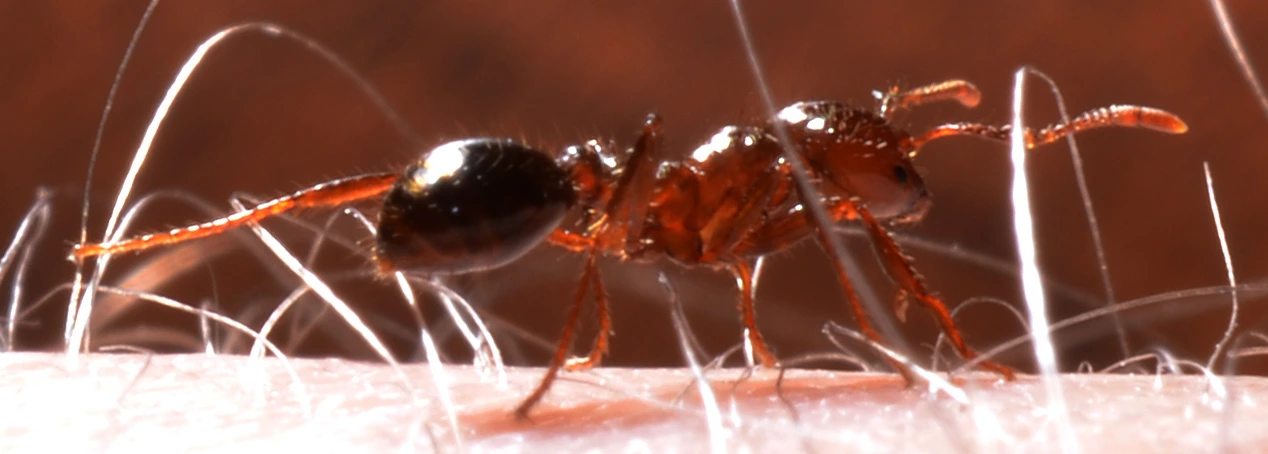
Fire Ants
Fire Ant Profile
| Feature | Details |
| Scientific Name | Solenopsis invicta (Red Imported Fire Ant) |
| Size | Workers vary: 1.5mm to 6mm (1/16 to 1/4 inch) |
| Other Names | Ginger ants, Stinging ants |
Key Identification
Don’t wait for a sting to identify these ants. Look for these distinct environmental and physical markers:
- The Mound: Unlike many ants that leave a hole in the center of a hill, fire ant mounds are dome-shaped and have no central opening. They look like piles of fluffed-up soil, often appearing suddenly after a heavy Florida rain.
- Aggressive Behavior: If the mound is disturbed, hundreds, sometimes thousands of ants will swarm out almost instantly, climbing vertical surfaces to attack.
- Appearance: They are reddish-brown to black with a darker abdomen. They are “polymorphic,” meaning you will see many different sizes of ants in the same colony.
- The Sting: They don’t just bite; they anchor with their mandibles and sting repeatedly, injecting a toxic alkaloid venom (solenopsin).
About Fire Ants in Florida
Fire ants are an invasive species that has completely reshaped the Florida landscape. They thrive in our sandy soil and open, sunny areas like lawns, golf courses, and pastures.
They are notoriously “water-resistant.” During Florida floods or hurricanes, fire ants are known to link their bodies together to form a living raft, floating on the water’s surface until they reach dry land—or your porch. They are also strangely attracted to electrical currents, often nesting in air conditioning units, pool pumps, and circuit breakers, causing expensive short circuits.
How to Treat
Mound-to-mound treatment (pouring chemicals on one hill) is rarely effective because it just causes the queen to move. We use a “broadcast” strategy for long-term ant control.
- Broadcast Baiting: We apply professional-grade bait in spotted areas. The workers find these “food” particles and take them deep into the colony to the queen. This is the only way to ensure the colony cannot reproduce.
- Ongoing Maintenance: Florida’s heat allows fire ants to breed year-round. Regular perimeter checks and treatments are the only way to ensure new colonies don’t “blow in” from neighboring properties, especially new developments.
Frequently Asked Questions About Fire Ants in Florida
Why do fire ant stings turn into white pustules?
The venom of a fire ant contains a high concentration of toxins that kill skin cells at the site of the sting. This results in a small, white, fluid-filled blister (pustule) about 24 hours later. Do not pop these, as it can lead to a secondary infection.
Can fire ants kill my grass?
Not directly. They don’t eat the grass, but their massive mounds can smother the turf, and their extensive tunneling can dry out the root systems, leading to brown patches in your Florida lawn.
Are fire ants dangerous to pets?
Yes. Pets of all sizes, or animals tethered in a yard, are at risk of being swarmed. If allergic, pets can go into anaphylactic shock. Fire ants often target the sensitive areas around a pet’s eyes, ears, and paws. If your pet is swarmed, contact a veterinarian immediately.
Our Orlando Service Locations:
- Orlando
- Clermont
- Apopka
- Windermere
- St. Cloud
- Winter Garden
- Lake Buena Vista
- Kissimmee
- Sanford
- Davenport
- Oakland
- Minneola
- Lake Nona
- Ocoee
- Longwood
- Lake Mary
- Oviedo
- Winter Park
- Altamonte Springs
Our Southwest, FL Service Locations:
- Fort Myers
- Cape Coral
- Naples
- Babcock Ranch
- Lehigh Acres
- Ave Maria
- Estero
- Bonita Springs
- Marco Island
- Sanibel Island