

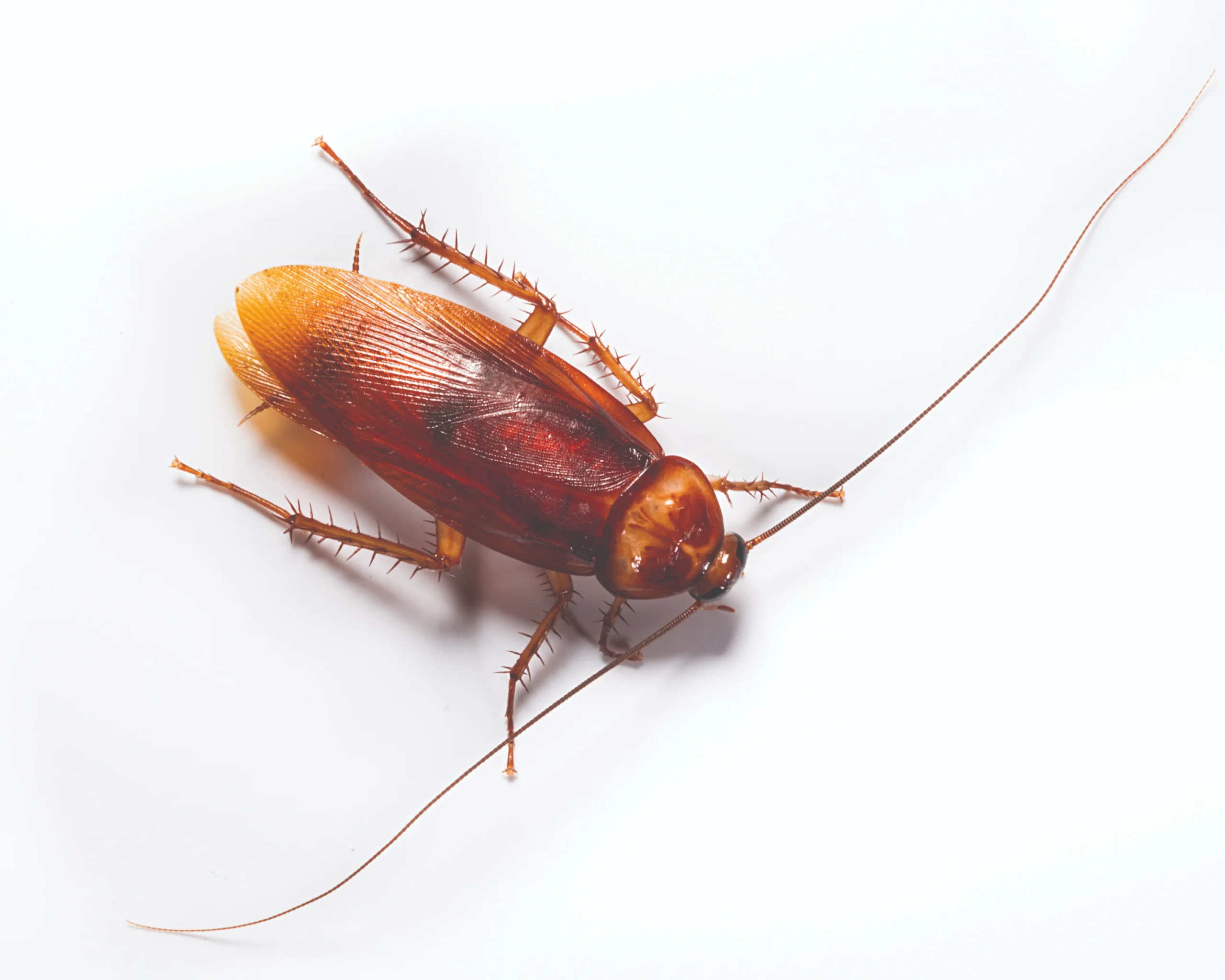
Palmetto Roaches
Palmetto Roach Profile
| Feature | Details |
| Scientific Name | Periplaneta americana (American Cockroach) |
| Size | 1.5 to 2+ inches long |
| Special Ability | They can fly (especially in high humidity), Water Bugs |
Key Identification
The “Palmetto Roach” is Florida’s most commonly known cockroach, and its appearance comes in different large sizes, shades of brown, and flight.
- The Size: These are the giants of the roach world, often reaching the length of a human thumb. The term “palmetto roach” is a general term for most roaches found in FL. An example of an exception is the German Roach.
- The Color: They can be a shiny, reddish-brown or mahogany color with a pale yellow band around the edge of their “shield”. There are others that are light brown, with a silky looking back.
- The Flight: Since palmetto roach is usually a generalized term, it depends on the exact species of roach for flight. Some fly, others do not.
- The Habitat: They prefer the great outdoors—specifically palm trees (hence the name), mulch, and hollow logs—but they will enter homes looking for water or to escape extreme heat.
About Palmetto Roaches in Florida
Palmetto roaches are essentially “moisture seekers.” They thrive in Florida’s subtropical climate but require high humidity to survive. When we have a dry spell, they follow the scent of water through your pipes, vents, and under door sweeps.
While they don’t typically “infest” a kitchen the way German roaches do, they are still a health risk. They travel through sewers and decaying leaf litter, picking up bacteria that they then track across your floors and countertops. Furthermore, seeing one inside usually indicates a gap in your home’s “envelope” that needs to be sealed.
How to Treat
Because Palmetto roaches live primarily outside, we focus our efforts on the exterior perimeter to keep them from ever crossing your protective barrier.
- Perimeter Treatment: We apply a liquid barrier around the entire foundation, windows and doors, utility penetrations, and the soffits and eaves. This creates a “no-fly zone” that rids of roaches on contact as they try to enter.
- Granular Baiting: We use weather-resistant granules in flower beds and mulch zones. Palmetto roaches are scavengers; they will eat the bait and be gone before they reach your front door.
- Exclusion (Seal the Gaps): Palmetto roaches are flat and can squeeze through surprisingly small cracks. We inspect and recommend fixes for worn weather stripping, torn screens, and gaps around plumbing.
FAQ Section
Why do Palmetto roaches fly at people?
They aren’t actually attacking! Palmetto roaches are attracted to light, and they are clumsy flyers. If you are standing in a doorway or near a light, they may simply lose control and glide toward you by accident.
Does seeing one Palmetto roach mean I have thousands?
Not necessarily. Unlike German roaches, Palmetto roaches are often “accidental invaders.” However, if you are seeing them frequently, it means there is an easy entry point or an overpopulation in your mulch or palm trees that needs to be addressed.
Why do they always die on their backs?
Palmetto roaches have a high center of gravity and long, spindly legs. When they are affected by a product that attacks their neurological system (or even just old age), they lose muscle coordination, flip over, and are unable to right themselves. If they consume a gel bait, they will usually die face down.
Our Orlando Service Locations:
- Orlando
- Clermont
- Apopka
- Windermere
- St. Cloud
- Winter Garden
- Lake Buena Vista
- Kissimmee
- Sanford
- Davenport
- Oakland
- Minneola
- Lake Nona
- Ocoee
- Longwood
- Lake Mary
- Oviedo
- Winter Park
- Altamonte Springs
Our Southwest, FL Service Locations:
- Fort Myers
- Cape Coral
- Naples
- Babcock Ranch
- Lehigh Acres
- Ave Maria
- Estero
- Bonita Springs
- Marco Island
- Sanibel Island