

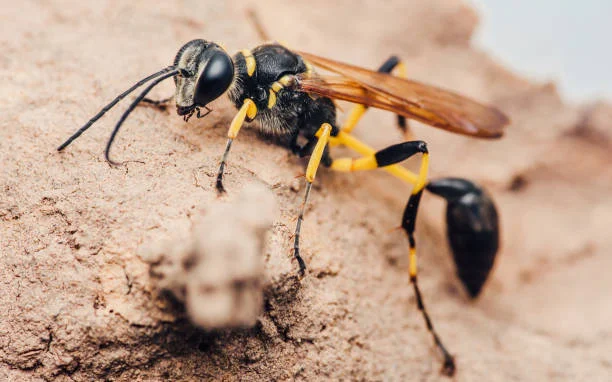
Mud Daubers
Mud Dauber Profile
| Feature | Details |
| Scientific Name | Sceliphron caementarium (Black and Yellow) & Chalybion californicum (Blue) |
| Size | 0.5 to 1 inch long |
| Nest Type | Hardened mud “tubes” or “clumps” |
Key Identification
Mud daubers are easily distinguished from other wasps by their unique body shape and building materials.
- The “Thread-Waist”: They have an extremely thin, needle-like waist (petiole) connecting their thorax and abdomen.
- The Color: In Florida, you’ll most likely see the Black and Yellow Mud Dauber or the striking, metallic Blue Mud Dauber.
- The Nest: They build nests out of wet mud and their saliva. These look like long, parallel organ pipes or messy “splats” of dried dirt on the walls of your home.
- Solitary Nature: Unlike yellow jackets, they do not live in colonies. You will usually see only one female working on a nest.
About Mud Daubers in Florida
Mud daubers are actually the “good guys” of the wasp world—they are the primary predators of spiders, including the Black Widow. The female hunts spiders, paralyzes them with venom, stuffs them into the mud tube, and lays an egg on top.
However, in Florida, they are considered a major nuisance. Their mud nests can stain stucco and siding, clog pool pump vents, and even interfere with outdoor ceiling fans. Because they are solitary, they aren’t “aggressive,” but they will sting if handled or if their nest is physically threatened.
How to Treat
Treating mud daubers is more about prevention and cleaning than heavy product use.
- Nest Removal & Pressure Washing: We are able to safely remove the nest as best we can. Since it is made from the acidic saliva of the mud dauber, we suggest you power wash or paint over parts of the nest that aren’t easily removable.
- Spider Control: Since spiders are their only food source, a general pest control plan that reduces the spider population on your property will naturally cause mud daubers to hunt elsewhere.
Frequently Asked Questions About Mud Daubers
Are mud daubers dangerous to my family?
Generally, no. They are very docile and rarely sting humans. They do not have the “nest-guarding” instinct that social wasps have. However, you should still avoid touching their nests with bare hands.
What are those holes in the mud nests?
If you see a hole in a mud nest, it means the baby wasp has already reached adulthood and “chewed” its way out. If there are no holes, the nest is likely still active and full of paralyzed spiders and developing larvae.
Why do they love my stucco house so much?
Stucco provides the perfect textured surface for mud to “grip.” In Florida, the humidity keeps the mud from drying too quickly while the female is building, making our homes the ideal construction site for their nests.
Our Orlando Service Locations:
- Orlando
- Clermont
- Apopka
- Windermere
- St. Cloud
- Winter Garden
- Lake Buena Vista
- Kissimmee
- Sanford
- Davenport
- Oakland
- Minneola
- Lake Nona
- Ocoee
- Longwood
- Lake Mary
- Oviedo
- Winter Park
- Altamonte Springs
Our Southwest, FL Service Locations:
- Fort Myers
- Cape Coral
- Naples
- Babcock Ranch
- Lehigh Acres
- Ave Maria
- Estero
- Bonita Springs
- Marco Island
- Sanibel Island