

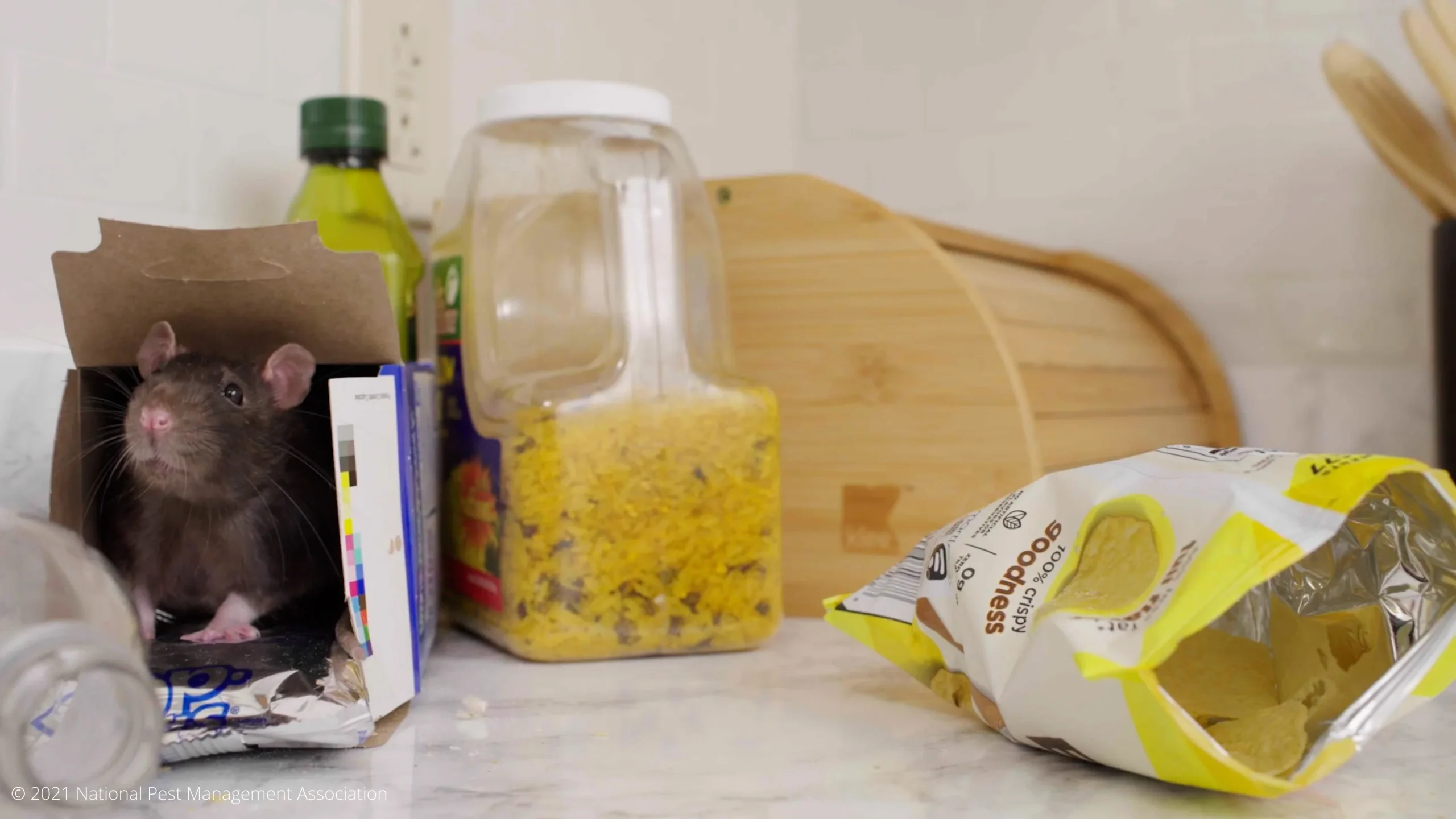
Rats
Rat Profile
| Feature | Details |
| Common Species | Roof Rat (Rattus rattus) & Norway Rat (Rattus norvegicus) |
| Size | 6 to 8 inches (plus a 7-inch tail) |
| Common Entry | Roof lines, soffits, and AC chase lines |
Key Identification
Knowing which rat you are dealing with determines where we look for them.
- The Roof Rat (Florida Palm Rat): Very common in Florida. Sleek, black or grey, with a tail longer than its body. They are “arboreal,” meaning they live in palm trees and travel along power lines to reach your roof.
- The Norway Rat: Stocky, brown, with a tail shorter than its body. These are burrowers that usually enter through the ground floor or plumbing.
- Droppings: Rat droppings are blunt, capsule-shaped, and about 1/2 to 3/4 inch long (much larger than mouse droppings).
- Gnaw Marks: Rats must chew to keep their teeth sharp and manicured. You’ll see large teeth marks on wood, PVC pipes, and—most dangerously—electrical wiring.
- Grease marks: Rats have an oily coat that leaves grease marks on heavily trafficked areas. This often can show potential entry points.
About Rats in Florida
Florida’s “Garden of Eden” provides rats with year-round food sources, from citrus trees and bird feeders to pet food left on lanais. Because we don’t have a true winter, rats breed continuously. A single pair of rats can lead to an infestation of dozens in just a few months.
The Roof Rat is specifically adapted to the Florida lifestyle. They use overhanging oak branches and palm fronds as bridges to your roof. Once they find a gap as small as a quarter, they move into your attic, compressing your insulation and contaminating it with urine and pheromones that attract even more rodents.
How to Treat
Rat control in Florida requires a permanent solution, not just a “quick fix” trap. We use a three-stage process:
- Total Exclusion: We identify every potential entry point from the foundation to the peak of the roof. We use high-grade materials and industrial sealants to “bolt the door” shut.
- Trapping: When there are rats present, we use a targeted trapping program to remove the rodents trapped inside.
- Exterior Population Management (Rodent Monitoring): We set up tamper-resistant bait stations around the exterior perimeter to reduce the local population before they even try to climb your home. As well as actively monitoring these stations to remove unwanted guests and replace bait.
Frequently Asked Questions About Florida Rats
I hear scratching in my ceiling at night. Is it a rat?
In Florida, nocturnal scratching in the attic is almost always a Roof Rat. Unlike squirrels, which are active during the day, rats wait until dark to move around, making them easy to hear when the house is quiet.
Can rats chew through the “Great Stuff” foam?
Yes. Standard expanding foam is no match for a rat’s teeth. Professional exclusion requires “rat-proof” materials like hardware cloth, metal flashing, and/or specialized concrete-infused sealants.
Why shouldn’t I use poison pellets in my attic?
Using poison indoors is a major risk. A poisoned rat will often crawl deep into a wall or under floorboards to die. In the Florida heat, the resulting odor is unbearable and can last for weeks, or even months, often requiring expensive drywall removal to locate the carcass.
Our Orlando Service Locations:
- Orlando
- Clermont
- Apopka
- Windermere
- St. Cloud
- Winter Garden
- Lake Buena Vista
- Kissimmee
- Sanford
- Davenport
- Oakland
- Minneola
- Lake Nona
- Ocoee
- Longwood
- Lake Mary
- Oviedo
- Winter Park
- Altamonte Springs
Our Southwest, FL Service Locations:
- Fort Myers
- Cape Coral
- Naples
- Babcock Ranch
- Lehigh Acres
- Ave Maria
- Estero
- Bonita Springs
- Marco Island
- Sanibel Island