
Orb Weavers
Spiny Orb Weaver Profile
| Feature | Details |
| Scientific Name | Gasteracantha cancriformis |
| Size | Females: 5mm to 9mm (roughly the size of a fingernail) |
| Other Names | Crab spider, Thorn spider |
Key Identification
You don’t need to be an expert to spot a Spiny Orb Weaver; their “armor” makes them stand out in any Florida garden.
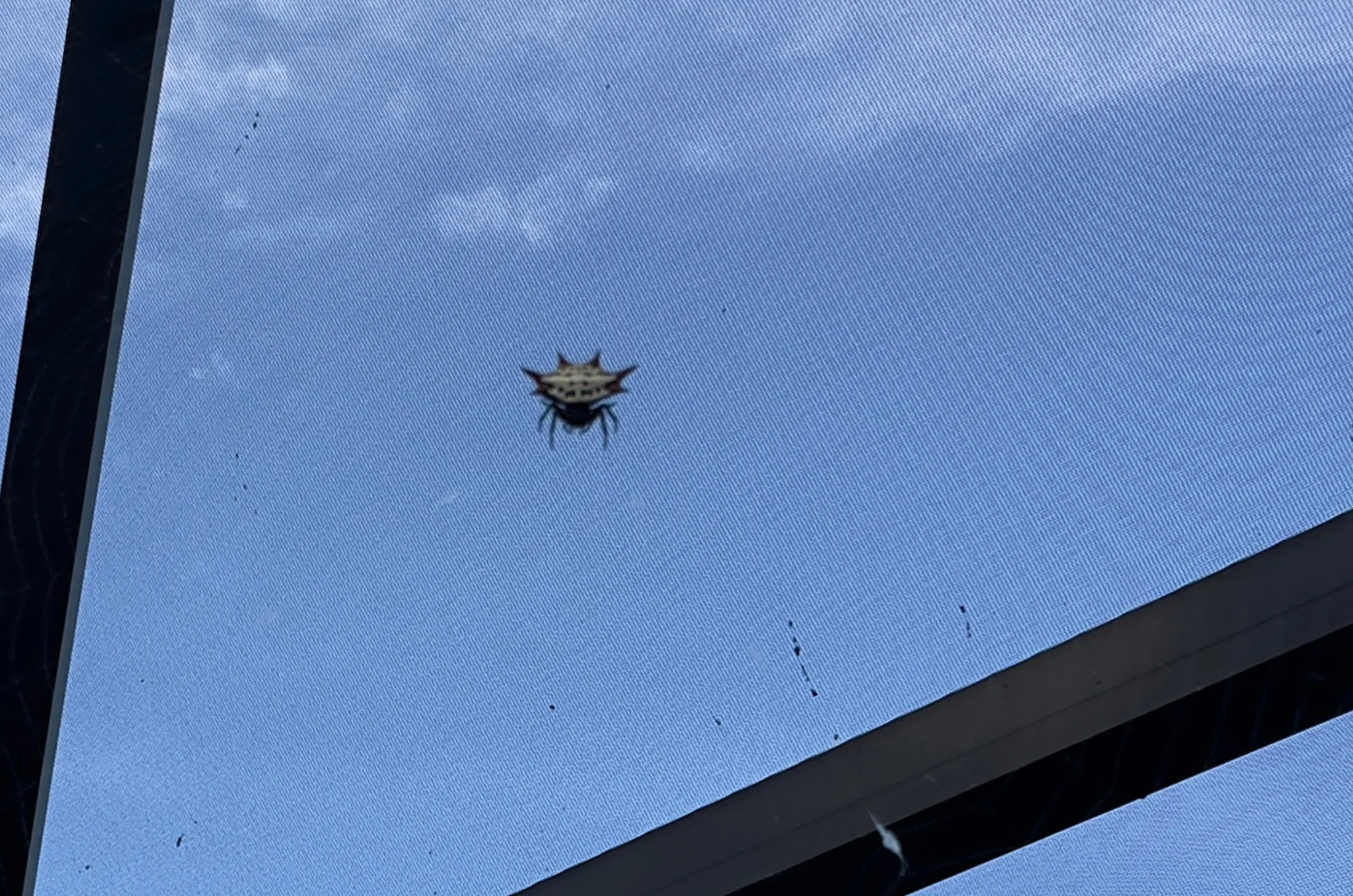
- The “Shell”: They have a hard, flat, crab-like abdomen with six prominent spines (spikes) along the edges.
- The Colors: In Florida, these spiders are mostly white with black spots and red spines. You may find other variations like yellow or orange.
- The Web: They spin classic, circular “orb” webs. A unique feature is the “tufts” of silk they often add to the web’s support lines.
- The “Tiny” Male: Like many spiders, the males are much smaller and lack the impressive spines of the females.
About Spiny Orb Weavers in Florida
Spiny Orb Weavers are year-round residents of the Sunshine State. Mainly found outdoors or in your lanai, suspended between citrus trees, shrubs, or the corners of your pool cage. They are passive hunters that sit in the center of their webs all day, catching and eating small flying pests like mosquitoes, gnats, and whiteflies.
How to Manage
Because these spiders are beneficial and don’t “infest” homes, we focus on web management rather than extermination.
- Entire Pool Cage Treatment (Advanced Spider Control): Spiny Orb Weavers love the structure of pool enclosures. We provide professional solutions and de-webbing services to keep your lanai looking clean from top to bottom.
- Vegetation Maintenance: They use “bridge lines” to span the distance between trees and your house. By trimming back overhanging branches, you significantly reduce their ability to build webs across your walkways.
- Lighting Adjustments: Since they build webs where the food is, switching to yellow “bug bulbs” on your porch will reduce the number of flying insects, naturally encouraging the spiders to move further into the yard. In addition, making a conscious effort to turn lights off, rather than keeping them on all night long, will help reduce build up.
Frequently Asked Questions On Spiny Orb Weavers
Are Spiny Orb Weavers poisonous?
No. While they do have venom to paralyze the small insects they eat, it is harmless to humans and pets. A bite is extremely rare and only happens if the spider is squeezed. The sensation is less painful than a typical bee sting.
Why do they have spikes on their backs?
The spines are a defense mechanism. They make the spider a very “uncomfortable” snack for birds and lizards, helping them survive in the predator-rich Florida environment.
Will they lay eggs inside my house?
No, not indoors, but potentially in the eaves in the covered pool cage area. If in the complete outdoors, Spiny Orb Weavers tend to lay their eggs in small, yellowish silk sacs on the underside of leaves outdoors, soffits and eaves, and from the beams of your pool cage. They do not seek out indoor environments to reproduce.
Our Orlando Service Locations:
- Orlando
- Clermont
- Apopka
- Windermere
- St. Cloud
- Winter Garden
- Lake Buena Vista
- Kissimmee
- Sanford
- Davenport
- Oakland
- Minneola
- Lake Nona
- Ocoee
- Longwood
- Lake Mary
- Oviedo
- Winter Park
- Altamonte Springs
Our Southwest, FL Service Locations:
- Fort Myers
- Cape Coral
- Naples
- Babcock Ranch
- Lehigh Acres
- Ave Maria
- Estero
- Bonita Springs
- Marco Island
- Sanibel Island