

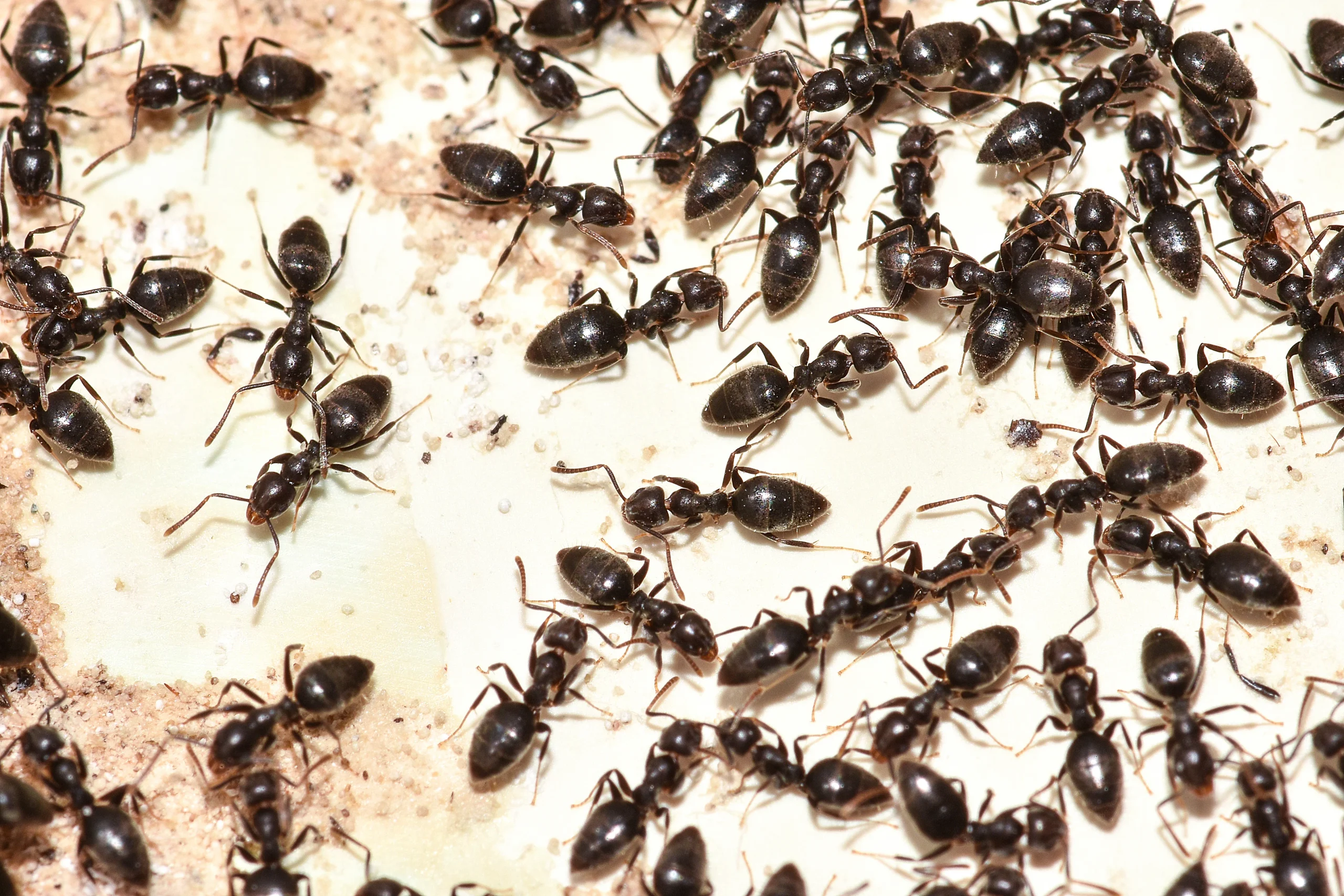
White Footed Ants
White-Footed Ant Profile
| Feature | Details |
| Scientific Name | Technomyrmex difficilis |
| Size | Small (approx. 2.5mm to 3mm) |
| Color | Jet black with pale “yellowish-white” feet |
Key Identification
White-footed ants are often confused with Ghost Ants or Crazy Ants, but they have several distinct traits:
- The “Tuxedo” Look: They have a solid black body, but if you look closely (or use a magnifying glass), their “feet” (tarsi) are pale or white.
- Massive Trails: They travel in very long, thick, and well-defined lines. You will often see them trailing up the sides of Florida homes, along utility lines, or following the “shadow” of a roofline.
- Sheer Numbers: Their colonies are enormous, often containing up to 3 million individuals.
- No “Stomach” Sharing: Unlike most ants, white-footed ants do not share food via regurgitation. Instead, they produce “trophic eggs” to feed the colony. This is why traditional “slow-acting” baits can fail.
About White-Footed Ants in Florida
White-footed ants thrive in Florida’s tropical climate and are especially common in South and Central Florida. They are “hedge-dwellers,” living in thick vegetation like hibiscus, ixora, and palm trees where they “farm” aphids for honeydew.
When they move indoors, they are looking for moisture and sweets. They are notorious for nesting in wall voids, attic insulation, and even inside electronics. Because they have multiple queens and can reproduce at an alarming rate, a small trail in the kitchen can lead to an infestation of hundreds of thousands within weeks.
How to Treat
Because these ants don’t share food traditionally, “over-the-counter” ant traps are almost completely ineffective. We use a systemic approach:
- Non-Repellent Liquid Barriers: We use specialized products that the ants cannot detect. They walk through the treatment and carry it back to the colony on their bodies (the “Transfer Effect”), eliminating the population without the need for food sharing.
- Honeydew Mimicry: We use high-moisture EPA gel baits that mimic the honeydew they crave. While they won’t share it as effectively as other ants, a thorough application in trailing areas significantly reduces the foraging population.
- Entry Point Sealing: When finding cracks in the stucco and gaps in door frames, it is best practice to get these points sealed up. We can help you identify where you need to seal these points.
Frequently Asked Questions on White Footed Ants
Why won’t the ant traps I bought at the store work?
White-footed ants have a unique biology. Most ants eat bait and vomit it up to feed the queen. White-footed ants don’t do this; they produce unfertilized eggs to feed the colony. If the foraging ants die from store-bought bait, the queens inside the wall remain perfectly fed and continue to lay eggs.
Do they cause structural damage?
No, they do not eat wood like termites. However, they can cause electrical shorts by nesting inside outlets, AC units, and appliances. Their sheer numbers also create significant sanitary issues on countertops and in pantries.
How did they get into my house?
They usually enter through the “path of least resistance.” This includes tree limbs touching the roof, gaps around window frames, or following the electrical wires that lead into your home.
Our Orlando Service Locations:
- Orlando
- Clermont
- Apopka
- Windermere
- St. Cloud
- Winter Garden
- Lake Buena Vista
- Kissimmee
- Sanford
- Davenport
- Oakland
- Minneola
- Lake Nona
- Ocoee
- Longwood
- Lake Mary
- Oviedo
- Winter Park
- Altamonte Springs
Our Southwest, FL Service Locations:
- Fort Myers
- Cape Coral
- Naples
- Babcock Ranch
- Lehigh Acres
- Ave Maria
- Estero
- Bonita Springs
- Marco Island
- Sanibel Island