

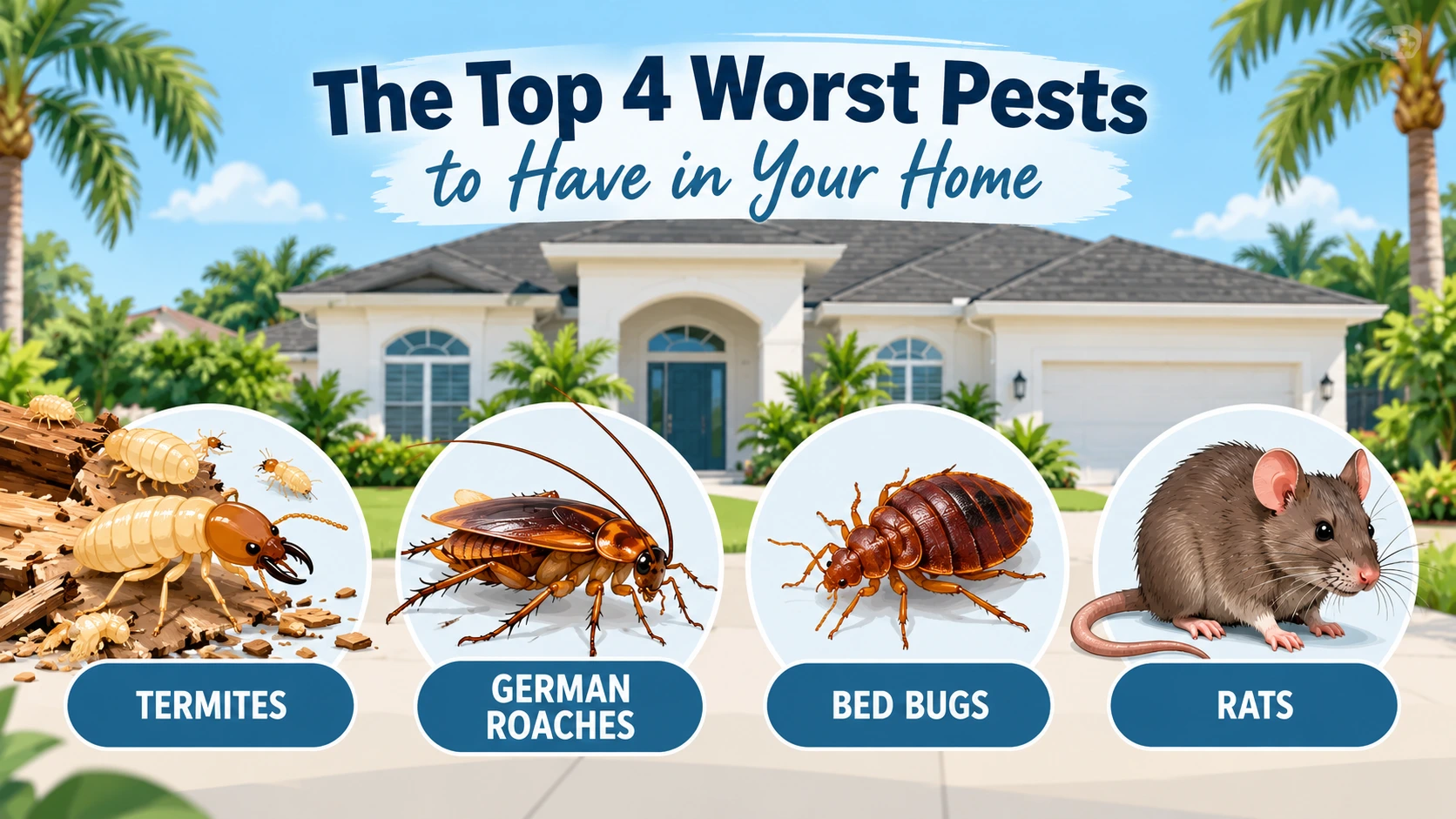
According to the expert technicians at Infinite Pest Solutions, termites take the number one spot because of their ability to silently cause extensive structural damage. German cockroaches, bed bugs, and rats follow closely behind due to their potential health risks, rapid reproduction, and property damage.
However, the worst household pest isn’t necessarily the one you see most often. Some of the most destructive infestations develop unnoticed for weeks, months, or even years.
At Infinite Pest Solutions, our technicians have encountered everything from thousands of German cockroaches crawling throughout a home to Formosan termites destroying flooring beneath a child’s bedroom.
We asked our pest control technicians which pests they consider the worst to encounter in a home and why. Their answers, combined with their firsthand experiences treating infestations throughout Fort Myers, Naples, Cape Coral and Clermont areas, helped us identify four pests homeowners should take particularly seriously. Whether you’re looking for pest control in Orlando or need assistance with an infestation elsewhere in our service areas, do not wait for a small pest problem to become a major infestation. Contact Infinite Pest Solutions today to discuss your concerns and treatment options.
What Are the 4 Worst Pests to Have in Your Home?
While every infestation presents different challenges, our technicians identified four household pests that consistently stand out.
| Rank | Household Pest | Primary Concern |
| 1 | Termites | Hidden structural damage and expensive repairs |
| 2 | German Cockroaches | Allergens, contamination, and rapid reproduction |
| 3 | Bed Bugs | Bites, difficult detection, and widespread infestations |
| 4 | Rats | Property damage, contamination, and electrical fire hazards |
Each of these pests can create significant problems for homeowners, but the severity of an infestation depends on how long the pests have been present, how widespread activity has become, and whether underlying conditions are addressed. Here’s what our technicians have experienced firsthand.
1. Termites: The Worst Pest for Structural Damage
Termites earn the number one position on our list because they’re capable of causing substantial damage without homeowners realizing what’s happening. Unlike pests that leave obvious signs of activity, subterranean termites can remain concealed within walls, beneath flooring, and inside structural components while feeding on cellulose-containing materials. By the time visible damage appears, an infestation may already be well established.
Why Are Termites So Destructive?
Subterranean termites live in colonies and forage for cellulose, which is found in wood and other building materials. Florida’s warm, humid environment creates favorable conditions for termite activity, making protection particularly important for homeowners throughout Fort Myers, Naples, Orlando, and surrounding communities.
Among species found in Florida, Formosan subterranean termites are especially concerning. They can develop extremely large colonies, and established infestations can cause substantial damage over time. Because activity is often hidden, homeowners may unknowingly allow infestations to continue until structural deterioration becomes apparent.
A Real Infestation: Formosan Termites Beneath a Child’s Bedroom Floor
One of our technicians recently encountered a severe Formosan termite infestation that demonstrates how easily warning signs can be overlooked. The homeowner had noticed what appeared to be dirt repeatedly accumulating inside her child’s bedroom closet. For approximately a month, she continued cleaning up the material, unaware that it could be associated with termite activity.
Eventually, the flooring began deteriorating. When the homeowner moved toys from the closet, portions of the flooring started coming apart. She had even attempted to hold the damaged flooring together with duct tape.
During our technician’s inspection, he removed the tape and discovered extensive active termite activity beneath the damaged flooring. What initially appeared to be a recurring housekeeping issue was actually a serious infestation. The homeowner hadn’t realized the extent of the problem developing beneath her feet.
The lesson: Repeated appearances of unexplained dirt-like material, damaged flooring, or other unusual changes around your home should not be ignored. Although these symptoms do not always indicate termites, they warrant further investigation.This customer went with her intuition to call in professionals and it’s a good thing she did.
Warning Signs of Termites in Your Home
- Mud tubes along foundations, walls, or other structural surfaces.
- Wood that sounds hollow or appears damaged.
- Bubbling, buckling, or deteriorating flooring.
- Discarded termite wings near windows or doors.
- Unexplained dirt-like material appearing around damaged areas.
- Swarming termites inside or around the home.
Not every termite species produces the same warning signs, and some infestations remain difficult to detect without a professional inspection.
Can You Get Rid of Termites Yourself?
Termite infestations are not something we recommend homeowners attempt to manage through DIY treatments. Treating visible activity does not eliminate the colony responsible for the infestation. For subterranean termites, successful management requires understanding how termites are accessing the structure and implementing an appropriate treatment strategy.
At Infinite Pest Solutions, we offer professional termite inspections and treatment options, including the Sentricon termite baiting system for subterranean termite protection.
Our technicians’ verdict: Termites are the worst overall household pest because they can cause significant property damage while remaining largely undetected.
2. German Cockroaches: One of the Worst Pests for Your Health
German cockroaches rank second because of their rapid reproduction, contamination risks, and ability to establish severe indoor infestations. Unlike some cockroach species that primarily live outdoors and occasionally wander inside, German cockroaches are strongly associated with indoor environments. They prefer warm areas near food, water, and shelter, making kitchens and bathrooms particularly attractive. When an infestation becomes severe, they can spread far beyond these areas.
Why Are German Cockroaches So Difficult to Eliminate?
German cockroaches reproduce quickly. A female carries an egg capsule containing numerous developing offspring, allowing populations to increase rapidly under favorable conditions. When homeowners ignore early activity, additional generations can develop, making the infestation increasingly difficult to control.
Their droppings, shed skins, and body fragments contain allergens that may trigger allergic reactions or worsen asthma symptoms in susceptible individuals. They can also contaminate surfaces and food through their movement between unsanitary areas and living spaces.
A Real Infestation: Thousands of German Cockroaches Throughout a Home
During one particularly severe service visit, a technician entered a home where German cockroaches had spread into nearly every room. Thousands were present throughout the property: crawling along walls during daylight hours, occupying kitchen cabinets and drawers, hiding beneath appliances, and infesting living areas. Cockroaches were even found among children’s toys.
Egg capsules were visible throughout the home, indicating an established breeding population. The infestation was so severe that cockroaches began crawling onto the technician while he worked. According to information reported during the service, a child living in the home was experiencing significant allergy problems.
Because of the severity of the infestation, ongoing treatment was necessary. A single visit was not sufficient to address the problem completely.
In another extreme infestation, two technicians used a shop vacuum to remove large numbers of adult German cockroaches. They filled the vacuum twice with cockroaches collected from the kitchen alone. Activity was present around doorjambs, hinges, corners, and numerous other hiding places throughout the property.
The Biggest Mistakes Homeowners Make With German Cockroaches
One common problem our technicians encounter is homeowners waiting too long to address German cockroach activity. Seeing a single German cockroach does not necessarily mean thousands are hiding nearby, but it should prompt investigation. Others rely on over-the-counter sprays without addressing the larger infestation. Improper product selection or application may fail to control established populations.
Another major concern is sanitation. Our technicians educate homeowners that cleaning is not simply putting dishes away or wiping down a countertop. It means thoroughly removing accessible food residue, grease, crumbs, grime, and buildup from areas where cockroaches feed and hide, including beneath appliances, around cabinets, and along kitchen surfaces.
Proper sanitation helps eliminate resources that support cockroach populations and improves professional treatment effectiveness. However, German cockroaches can infest clean homes, too. Poor sanitation can make an infestation worse, but it is not the only reason these pests become established.
Why Professional German Cockroach Treatment Matters
Severe infestations require more than treating the insects homeowners can see. A professional strategy must account for breeding populations, hidden activity, infestation severity, and conditions that allow cockroaches to thrive. At Infinite Pest Solutions, we evaluate each infestation individually and establish realistic expectations. For extensive infestations, follow-up treatments and continued cooperation may be necessary.
Our technicians’ verdict: German cockroaches are among the worst pests for household health and sanitation because their populations can grow rapidly and become extremely difficult to control.
3. Bed Bugs: One of the Most Stressful Household Infestations
Bed bugs rank third because of their ability to hide throughout a home, feed on sleeping occupants, and create significant emotional and physical discomfort. Although bed bugs are not known to transmit diseases to humans, their bites can cause itching, skin irritation, and allergic reactions in some individuals. Infestations may also contribute to sleep disruption, anxiety, and stress.
One of the biggest misconceptions about bed bugs is that they only infest dirty homes. The truth is that bed bugs can infest even the cleanest homes.
How Do Bed Bugs Get Into Your Home?
Bed bugs are hitchhiking pests. They can travel between locations by hiding in luggage, clothing, furniture, and other belongings. Travel and movement of infested items are common ways they enter homes. Once inside, they seek hiding places near areas where people rest or sleep. Bed bugs respond to cues including body heat and carbon dioxide and commonly emerge to feed when occupants are resting, although they can feed during daylight as well.
A Real Infestation: Bed Bugs Pouring Out of a Couch
One technician described an infestation so extensive that portions of the bed were heavily covered with visible bed bug activity and staining. But the bed was not the only problem. When the technician pressed down on the springs of a nearby couch, an enormous number of bed bugs emerged. The technician estimated that approximately a thousand bed bugs poured out onto his boot.
This demonstrates why inspecting only the mattress is not enough. Bed bugs may hide in:
- Mattress seams and bed frames.
- Couches and upholstered furniture.
- Dressers and bedside furniture.
- Cracks and crevices near sleeping areas.
- Wall hangings and picture frames.
- Other sheltered areas near places where people rest.
In another case, technicians treated a home where bed bug activity was suspected to have been present for approximately six months to a year. Multiple rooms required treatment. During a follow-up visit, technicians found a small amount of remaining activity and treated again. The company received no further reports afterward, although the absence of additional reports alone does not confirm elimination.
Why Do Some People Get Bed Bug Bites While Others Don’t?
Our technicians have encountered situations where one spouse reports waking up with bites while the other notices no symptoms. People react differently: some develop itching, redness, or swelling, while others show little or no visible reaction. The absence of bite marks on one person does not rule out an infestation. Skin reactions alone cannot confirm bed bugs because other insects and medical conditions can produce similar symptoms; identifying the insect or physical evidence is essential.
Why Homeowners Delay Bed Bug Treatment
Embarrassment and denial are two challenges our technicians have observed. Some homeowners associate bed bugs with poor cleanliness and hesitate to seek help; others assume the problem will disappear or treat only the bed. Delaying identification and appropriate treatment can allow an established infestation to expand. Successful treatment requires understanding their behavior and the extent of the infestation.
Our technicians’ verdict: Bed bugs are among the worst household pests because of the discomfort, stress, and treatment challenges associated with established infestations.
4. Rats: Dangerous Pests That Can Damage Your Home
Rats rank fourth, but homeowners should not consider them a minor concern. Rodents can contaminate stored food and living spaces, damage insulation, and chew through building materials. Gnawing on electrical wiring can create electrical hazards and potentially contribute to house fires. Rats may establish nests in difficult-to-access locations, including attics and wall voids.
A Real Infestation: Extensive Rat Activity Inside an Attic
One technician recalled opening an attic access and immediately hearing and seeing rats moving inside. After exclusion work, trapping continued over multiple visits. For approximately a month, traps were repeatedly triggered. Technicians sometimes discovered only portions of rodents remaining in the traps; the technician reported evidence consistent with other rodents consuming trapped animals. This demonstrates the difficulty of severe attic infestations.
Another Common Problem: Chicken Coops Attracting Rats
In another situation, technicians encountered a property with an estimated 30 or more rats associated with an accessible food source near a chicken coop. Spilled grain, accessible feed containers, and other food sources can provide rats with reliable feeding opportunities. Once established around a property, they may explore nearby structures for shelter. Our team recommended rodent monitoring using secured bait stations as part of the management strategy.
How Do Rats Get Into Florida Homes?
Rats exploit openings around a home’s exterior, including gaps near utility penetrations, rooflines, vents, and other structural openings. Overgrown vegetation and palm fronds touching a home may also provide climbing rodents with easier access to elevated parts of the structure. Homeowners are often unaware of these vulnerabilities.
Why Rodent Control Requires More Than Traps
Trapping may help remove rodents, but it does not necessarily address conditions that allowed them onto the property. Effective management may involve identifying entry points, recommending exclusion work, reducing accessible food sources, and implementing appropriate trapping and/or monitoring. Our approach depends on the property and severity of activity.
Our technicians’ verdict: Rats are among the worst household pests because they can create contamination risks, damage property, and establish infestations in areas difficult for homeowners to access safely.
What Makes a Pest Infestation So Difficult to Eliminate?
After years of treating infestations throughout Fort Myers, Cape Coral, Naples, and Orlando, our team has learned that successful pest management requires more than identifying which pest is present. No two infestations are exactly alike.
A German cockroach infestation in a heavily cluttered kitchen presents different challenges than one discovered early in a well-maintained property. A termite infestation beneath damaged flooring requires a different strategy than a rodent problem involving an attic and multiple exterior entry points. Infinite Pest Solutions does not believe in a one-size-fits-all approach.
Our technicians evaluate the situation, understand contributing factors, and recommend an appropriate course of action. Just as importantly, we believe in setting realistic expectations.
Why Homeowner Cooperation Matters
Professional pest control and homeowner cooperation work together. Severe German cockroach infestations may require sanitation improvements; rodent problems may require closing structural openings; and landscaping may need maintenance to reduce pest access. Some infestations also require multiple treatments or continued monitoring. Our goal is to explain both the treatment process and the steps homeowners can take to support lasting results.
How Can You Prevent the Worst Household Pests?
- Schedule professional termite or rodent inspections to help identify potential problems before damage becomes extensive.
- Address German cockroach activity early rather than assuming the problem will disappear.
- Maintain sanitation: remove food residue, clean beneath appliances, manage garbage, and reduce clutter.
- Inspect luggage and belongings after travel for signs of bed bugs.
- Hire a licensed professional to inspect exterior openings and address rodent entry points with appropriate exclusion methods.
- Trim vegetation that creates access routes to the structure.
- Store animal feed securely, especially around backyard chicken coops.
- Take unexplained dirt-like deposits, bites, cockroach sightings, or attic noises seriously.
Preventative measures cannot guarantee that pests will never enter your home, but they can reduce risks and make problems easier to identify.
Frequently Asked Questions About the Worst Household Pests in Naples, Ft Myers, and Orlando
What Is the Number One Worst Pest to Have in Your Home?
According to Infinite Pest Solutions’ technicians, termites are the worst overall household pest because they can silently cause extensive structural damage. Formosan subterranean termites are particularly concerning in Florida because established colonies can become extremely large and destructive.
What Household Pest Is the Hardest to Get Rid Of?
German cockroaches and bed bugs are among the most difficult household pests to eliminate once infestations become established. Both hide in difficult-to-reach areas, and severe infestations often require comprehensive strategies and follow-up visits.
What Pest Causes the Most Damage to Homes?
Termites are among the most destructive structural pests because they feed on cellulose-containing materials, including construction wood. Rodents can also cause substantial damage by chewing wiring, insulation, and other materials.
What Is the Most Unhealthy Pest to Have in Your House?
German cockroaches and rats are particularly concerning because of potential contamination. German cockroach allergens can worsen asthma and allergy symptoms, while rodents can contaminate food and surfaces and may carry disease-causing organisms.
Can a Clean House Still Have a Pest Infestation?
Yes. Bed bugs can arrive in luggage, termites can enter through concealed access points, and rodents can exploit exterior openings. Cleanliness reduces certain risks but does not eliminate every infestation.
Are German Cockroaches Worse Than Regular Cockroaches?
German cockroaches are particularly challenging because they reproduce quickly and establish breeding populations indoors. Other cockroach species can also cause problems, but German cockroaches are especially adapted to indoor living.
Should You Call Pest Control After Seeing One Bug?
It depends on the pest. One outdoor insect indoors may not indicate an infestation. However, identifying a German cockroach, bed bug, termite, or evidence of rodents warrants further investigation.
The Final Verdict: What’s the Worst Pest to Have at Home?
Termites are the worst pest to have at home when considering the potential for hidden structural damage and costly repairs. However, the answer changes depending on what concerns you most.
German cockroaches are particularly problematic because of rapid reproduction and potential health impacts. Bed bugs create discomfort and stress while hiding in multiple locations. Rats can damage wiring, contaminate living spaces, and establish infestations in difficult-to-access areas.
One thing all four pests have in common is that waiting to address an infestation can allow the problem to become more difficult to manage.
At Infinite Pest Solutions, we have seen firsthand how serious pest infestations become when warning signs are overlooked. Every home and infestation is different, so our technicians focus on identifying the problem, understanding the property, educating homeowners, and developing appropriate treatment recommendations.
Concerned About Pests in Your Florida Home?
Whether you are noticing signs of termites, struggling with German cockroaches, dealing with bed bugs, or hearing rodents in your attic, Infinite Pest Solutions is here to help.
We provide professional pest control services throughout Fort Myers, Naples, Orlando, and surrounding Southwest and Central Florida communities. Do not wait for a small pest problem to become a major infestation. Contact Infinite Pest Solutions today to discuss your concerns and treatment options.
Our Orlando Service Locations:
- Orlando
- Clermont
- Apopka
- Windermere
- St. Cloud
- Winter Garden
- Lake Buena Vista
- Kissimmee
- Sanford
- Davenport
- Oakland
- Minneola
- Lake Nona
- Ocoee
- Longwood
- Lake Mary
- Oviedo
- Winter Park
- Altamonte Springs
Our Southwest, FL Service Locations:
- Fort Myers
- Cape Coral
- Naples
- Babcock Ranch
- Lehigh Acres
- Ave Maria
- Estero
- Bonita Springs
- Marco Island
- Sanibel Island